
The Burden of Proof

Compound is a digital family office for entrepreneurs, professionals, and retirees who want the personal touch of a dedicated advisor accompanied by a beautiful digital experience.
Strong economic growth, another exceptional start to the earnings season, and robust investment in artificial intelligence provided investors with plenty of reasons for optimism in July. At the same time, persistent inflation, geopolitical tensions in the Middle East, and a perceived more hawkish tone from the Federal Reserve reminded investors that the path forward is unlikely to be straightforward. While the S&P 500 finished the month little changed, that result masked significant differences beneath the surface as leadership shifted toward value stocks, financials and energy, while many of the year's strongest technology and growth companies came under pressure.1
A defining feature of July was that investors became increasingly focused on the drivers of growth supporting the lofty expectations embedded in asset prices. The shift led to greater scrutiny beyond headline earnings growth to recurring operating profits, and beyond record AI investment to whether those investments are translating into sustainable earnings and productivity gains. As we enter the second half of the year, the economy continues to demonstrate resilience, but markets are demanding greater evidence that today's strong fundamentals can justify increasingly high expectations.
July 2026 at a glance
- Economy: Second-quarter GDP growth slowed to 1.5%, but private domestic demand remained considerably stronger bolstered by business investment—particularly in technology and AI infrastructure.2
- Earnings: Corporate earnings exceeded expectations across most sectors. While Q2 growth was inflated by large investment gains at Alphabet and Amazon, underlying operating earnings remained broadly strong, reinforcing the fundamental backdrop for equities.3
- Equity Markets: The S&P 500 finished the month little changed, masking a meaningful rotation in equities. Value stocks, financials and energy outperformed, while technology, growth stocks and semiconductors weakened as investors scrutinized AI-related capital spending more closely.4
- Fixed Income: Rising Treasury yields pressured most bond sectors as markets priced a longer period of tighter monetary policy. Higher starting yields are supporting income opportunities, while shorter-duration investments again demonstrated greater resilience than longer-duration bonds.5
- Inflation & Employment: Inflation moderated from spring highs but remained above the Federal Reserve's target.6 7 The labor market is cooling gradually through slower hiring rather than widespread layoffs, supporting consumer spending while easing concerns about an abrupt economic slowdown.8
- Federal Reserve: The Federal Reserve held interest rates steady at the July meeting, but three policymakers dissented in favor of a rate increase. Chair Kevin Warsh emphasized the Fed’s commitment to returning inflation to its 2% target and signaled that policy would remain data dependent with less forward guidance than investors have become accustomed to.9
- Artificial Intelligence: The AI conversation has shifted from enthusiasm toward execution. Investors increasingly focused on whether record levels of capital spending will translate into durable earnings growth in the face of growing competition and elevated valuations.
- Geopolitics: The ongoing conflict with Iran kept energy prices volatile, illustrating how geopolitical events can quickly influence inflation expectations, interest rates and market leadership even when the broader economic outlook remains constructive.
Stocks
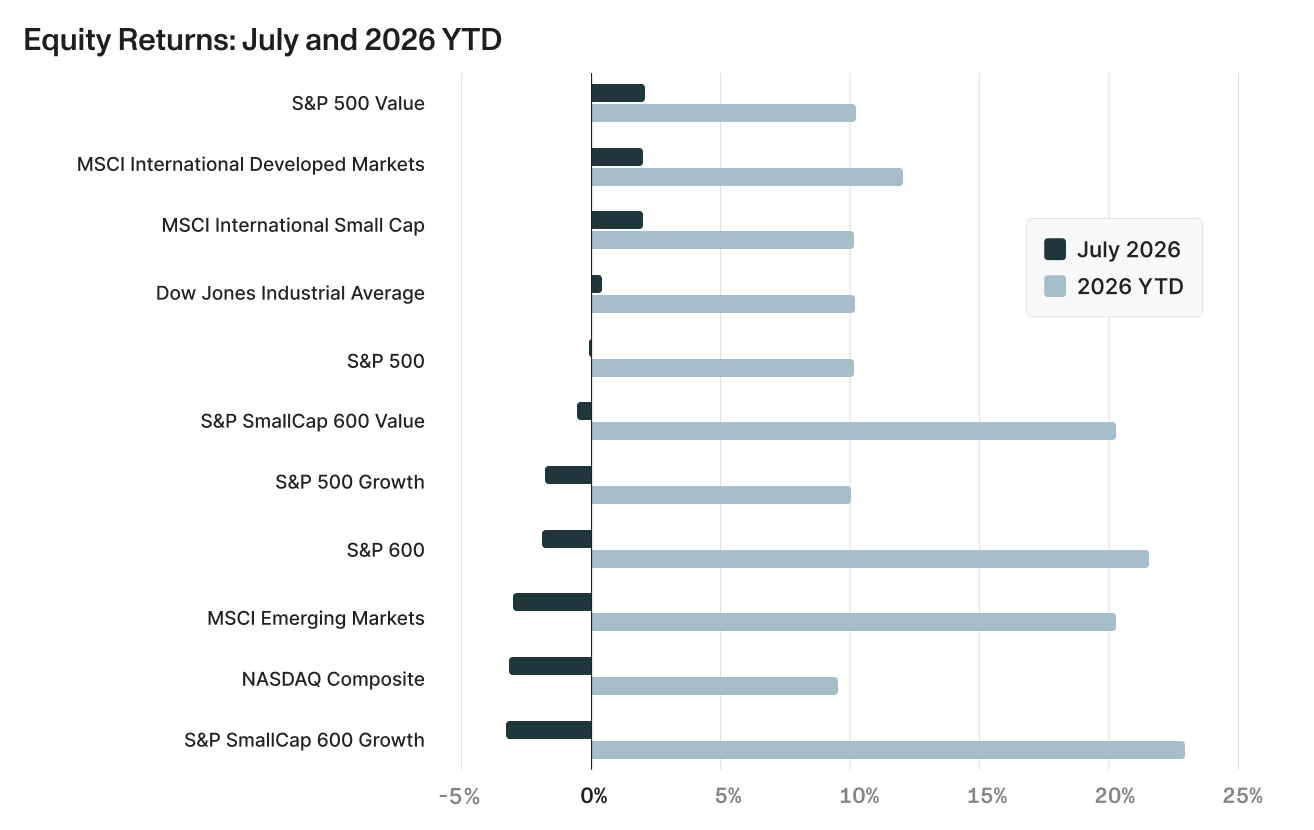
July illustrated how much the investment environment has evolved over the past year. While the S&P 500 finished the month essentially unchanged, that masked significant differences beneath the surface.10 Investors rotated away from many of the year's strongest technology and growth companies toward value stocks, financials and energy, reflecting a combination of higher interest rates, rising oil prices and increased scrutiny of AI-related capital spending.11
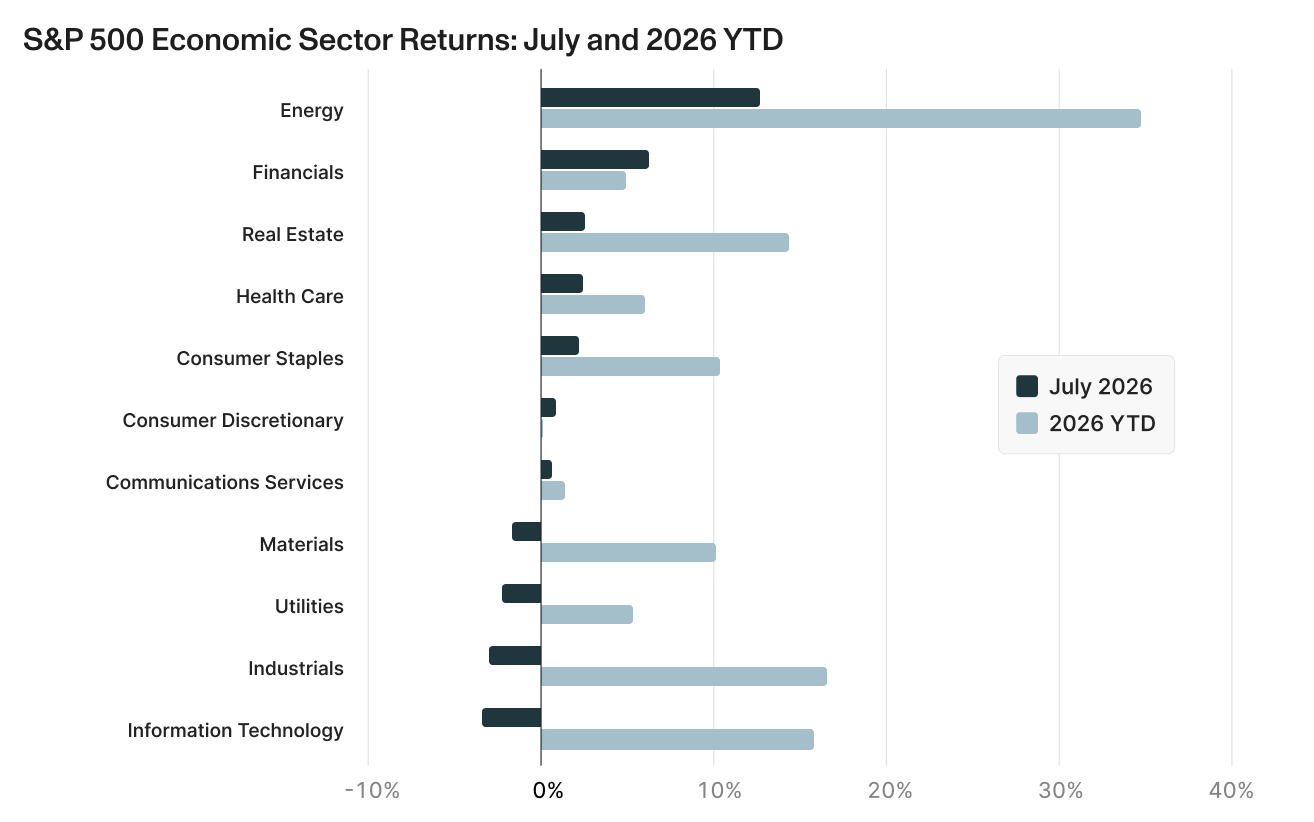
Sector performance highlighted that shift. Energy was the month's strongest performer as geopolitical tensions pushed oil prices higher. Financials also advanced following another strong earnings season and growing expectations that interest rates could remain elevated for longer. In contrast, information technology and industrials lagged as investors reassessed whether the pace of AI investment will ultimately translate into the exceptional earnings growth needed to justify current valuations.
While returns softened broadly during the month, July's rotation should not be viewed as a broad deterioration in equity markets. Corporate earnings remained exceptionally strong, economic activity continued expanding, and year-to-date performance across a wide range of asset classes remains solid. Instead, investors became more selective, rewarding companies with resilient earnings, stronger balance sheets and clearer paths to generating returns.
Fixed Income
Bond markets faced another challenging month as Treasury yields moved higher and most fixed-income sectors produced modestly negative returns. The Federal Reserve left interest rates unchanged at it’s July 29th meeting, but renewed geopolitical uncertainty and persistent inflation concerns led investors to increasingly expect rate increases over the rest of 2026. As a result, longer-duration bonds experienced the greatest pressure, while shorter-duration investments again demonstrated their resilience.
Performance differences across fixed-income sectors also reinforced the month's broader theme of selectivity. Credit-sensitive sectors generally held up better than longer-duration government and investment-grade bonds, suggesting that rising Treasury yields, and not widespread deterioration in corporate fundamentals, were the primary driver of returns. Municipal bonds also faced headwinds from rising rates and seasonal supply pressures, although higher yields have improved their long-term attractiveness for many taxable investors.
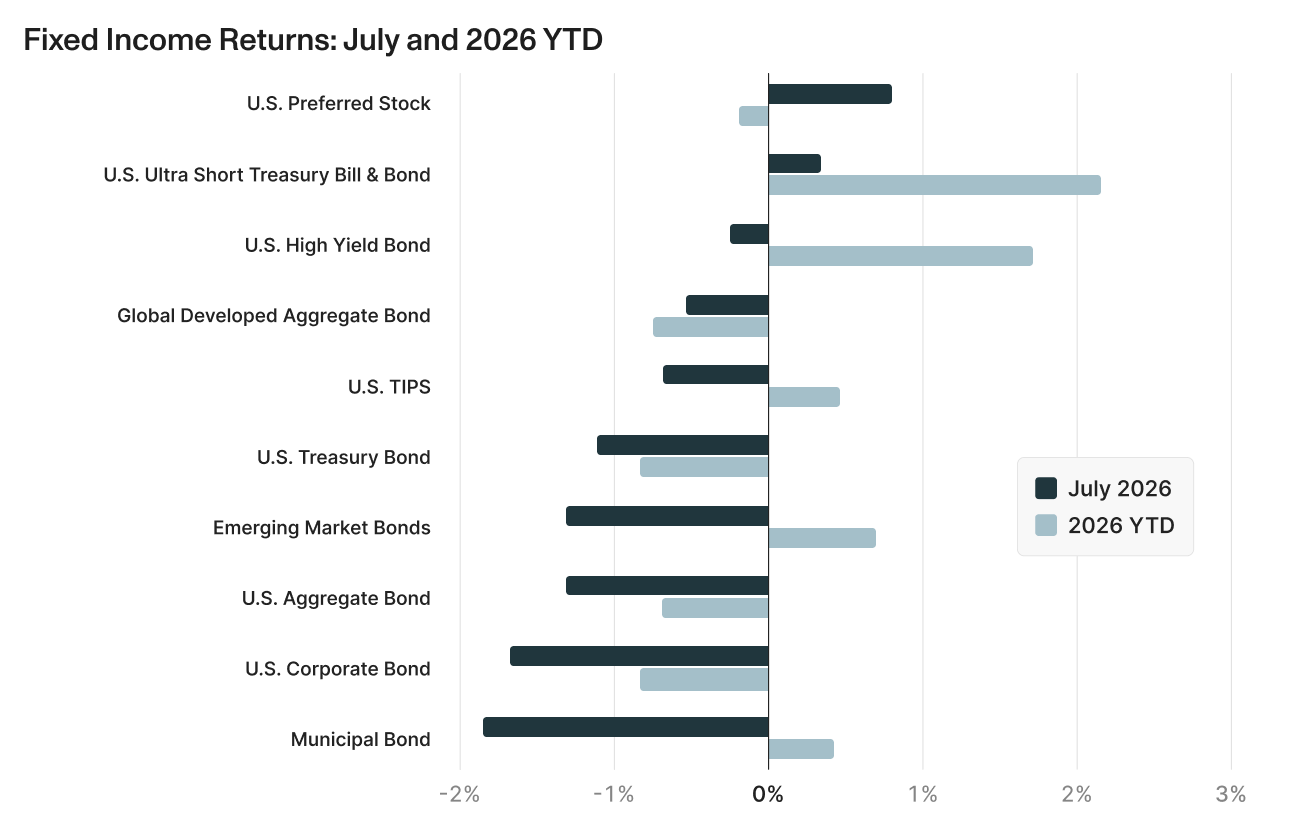
Despite July's price declines, the outlook for fixed income remains considerably different than it was just a few years ago. Higher starting yields provide attractive income opportunities and improve the long-term return potential for many bond sectors. Rather than relying on falling interest rates to generate returns, investors today can once again earn meaningful income while waiting for economic and policy uncertainty to evolve.
Private Markets
Private markets continued to normalize during July, although progress remained uneven across asset classes. Transaction activity improved, fundraising stabilized in several areas and new investment opportunities became increasingly attractive.17 At the same time, higher financing costs, slower exit activity and greater manager dispersion has further distinguished stronger portfolios from those facing more persistent challenges.18
Private equity benefited from a building recovery in mergers and acquisitions, particularly among larger strategic transactions and AI-related businesses. However, liquidity remained constrained for many older funds as elevated interest rates and valuation uncertainty continued delaying exits.19 As a result, manager quality, portfolio construction and the ability to generate realizations remained increasingly important differentiators.
Private credit also reflected a more mature stage of the credit cycle. Existing portfolios faced isolated credit stress, particularly among certain software and lower-middle-market borrowers, while new investments generally benefited from wider spreads, stronger lender protections and improving financing terms.20 Rather than representing a broad deterioration in fundamentals, the current environment increasingly favors disciplined underwriting and careful manager selection.
Conditions within private real estate are improving gradually. Lower construction activity, improving occupancy trends in sectors such as multifamily housing, industrial properties and senior housing, and more attractive entry valuations have strengthened the long-term outlook for selected property types.21 Higher interest rates, however, have slowed transaction activity and delayed a broad recovery in valuations. July reinforced that outcomes are becoming increasingly differentiated by property sector, leverage, location and manager expertise rather than by asset class alone.
Looking Beneath the Headlines
The Sources of Growth
At first glance, July's economic results appeared mixed. Second-quarter GDP growth came in at an annualized rate of 1.5%, the slowest pace in more than a year.22 A closer look, however, painted a considerably more positive picture. Much of the slowdown reflected temporary factors—including inventory reductions and a surge in technology-related imports—rather than weakening private demand. In fact, real final sales to private domestic purchasers, a measure that excludes the more volatile inventories, trade and government spending components of GDP, increased 3.9% during the quarter, highlighting the continued resilience of household spending and business investment.23
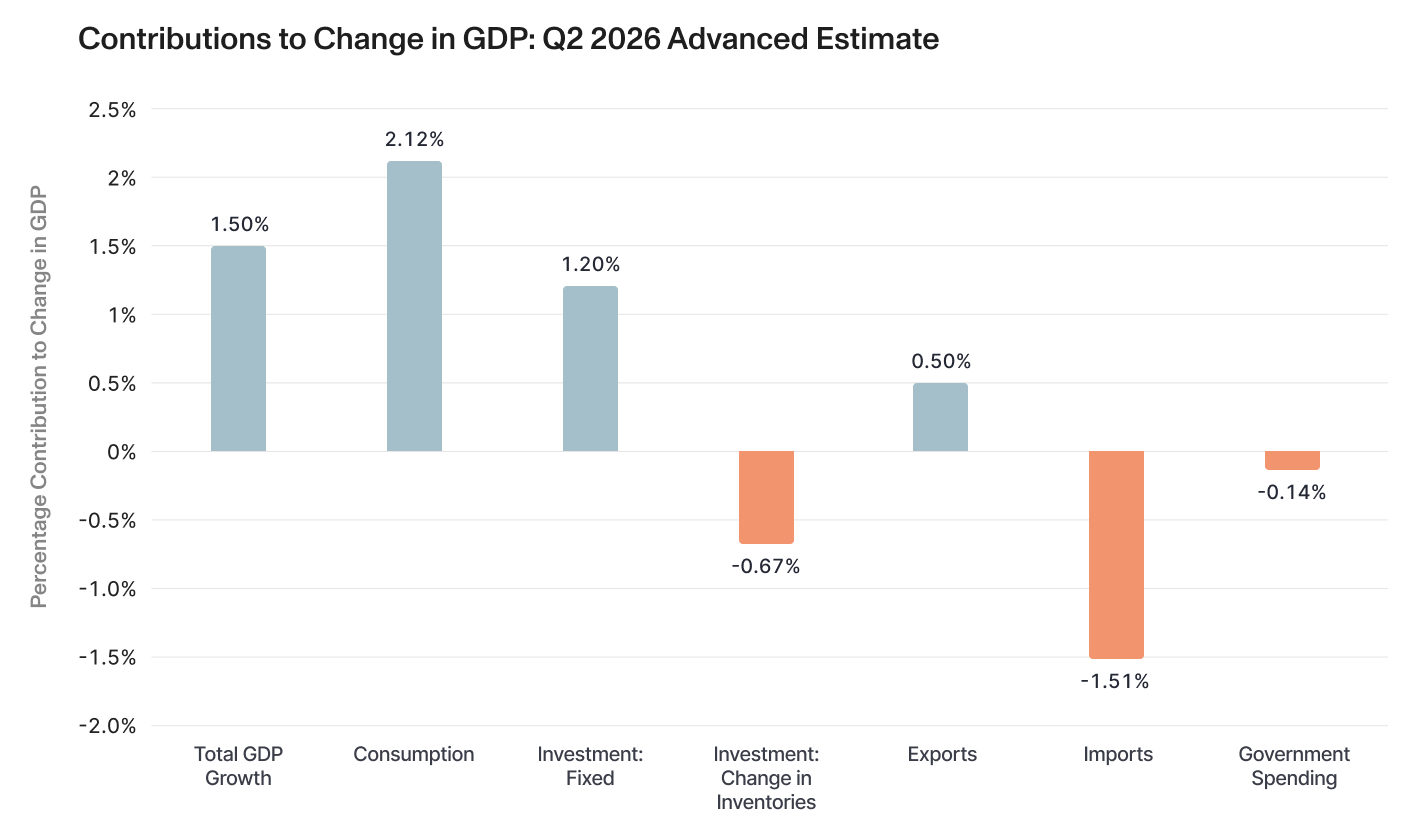
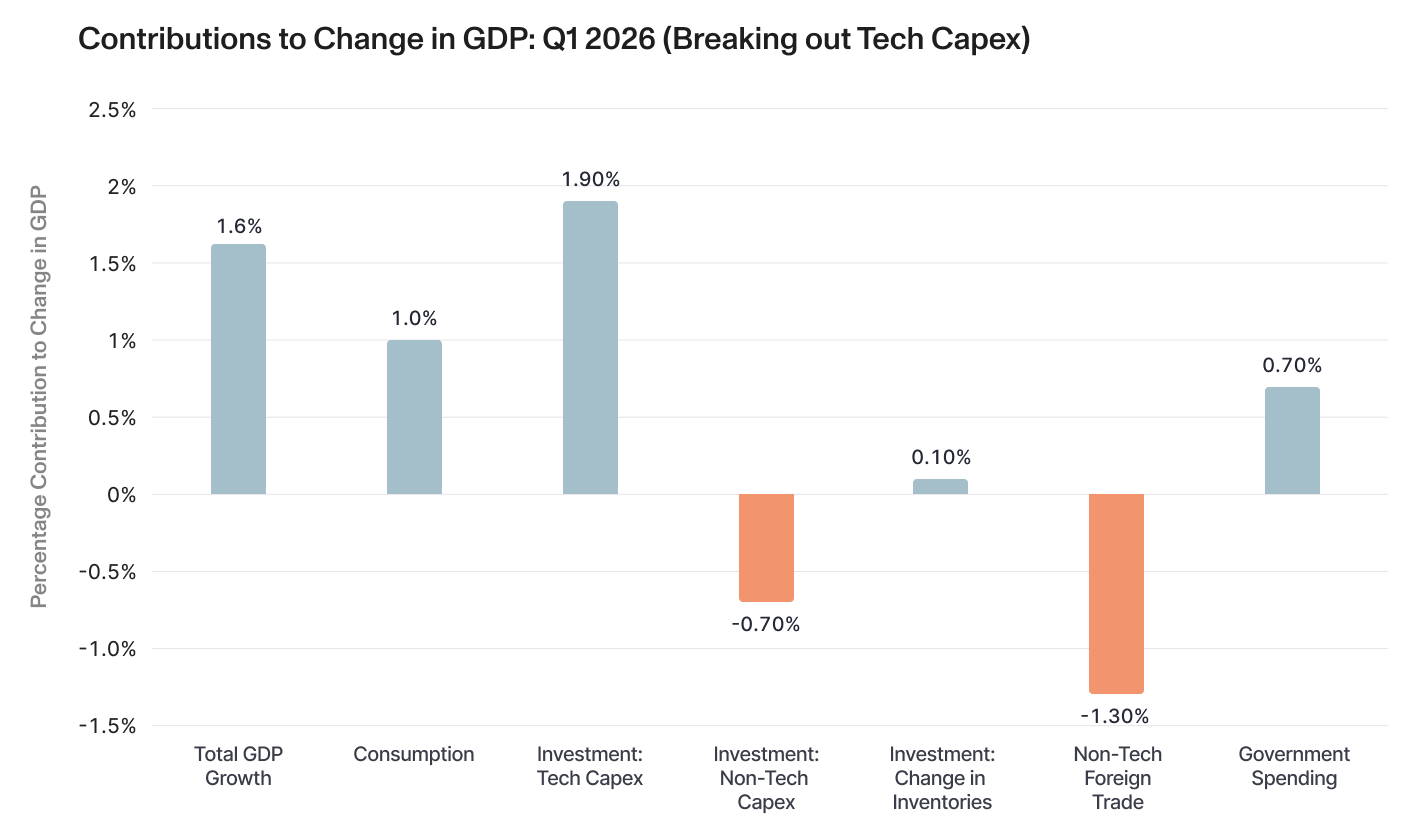
Business investment was one of the most important drivers of that strength, particularly spending on technology and artificial intelligence infrastructure. While AI has attracted most of the public attention, the broader investment cycle extends well beyond generative AI to include cloud computing, semiconductors, data centers, networking equipment and the power infrastructure required to support them. As the chart below breaking down Q1 2026 GDP growth illustrates, technology investment has become an increasingly important contributor to overall economic growth, helping offset softness in more interest-sensitive sectors of the economy.25
The Q2 earnings season has told a similar story thus far. At first glance, the S&P 500 companies that reported through the end of July delivered exceptional earnings growth of over 47%, but these results were significantly boosted by large investment gains at Alphabet and Amazon. Even after adjusting for those non-operating gains, earnings growth remained exceptionally strong at nearly 29%—well above long-term averages and supported by broad-based revenue growth, resilient profit margins and continued strength across many sectors of the economy.27 In other words, the earnings picture became somewhat less spectacular after looking beneath the surface, but no less encouraging.
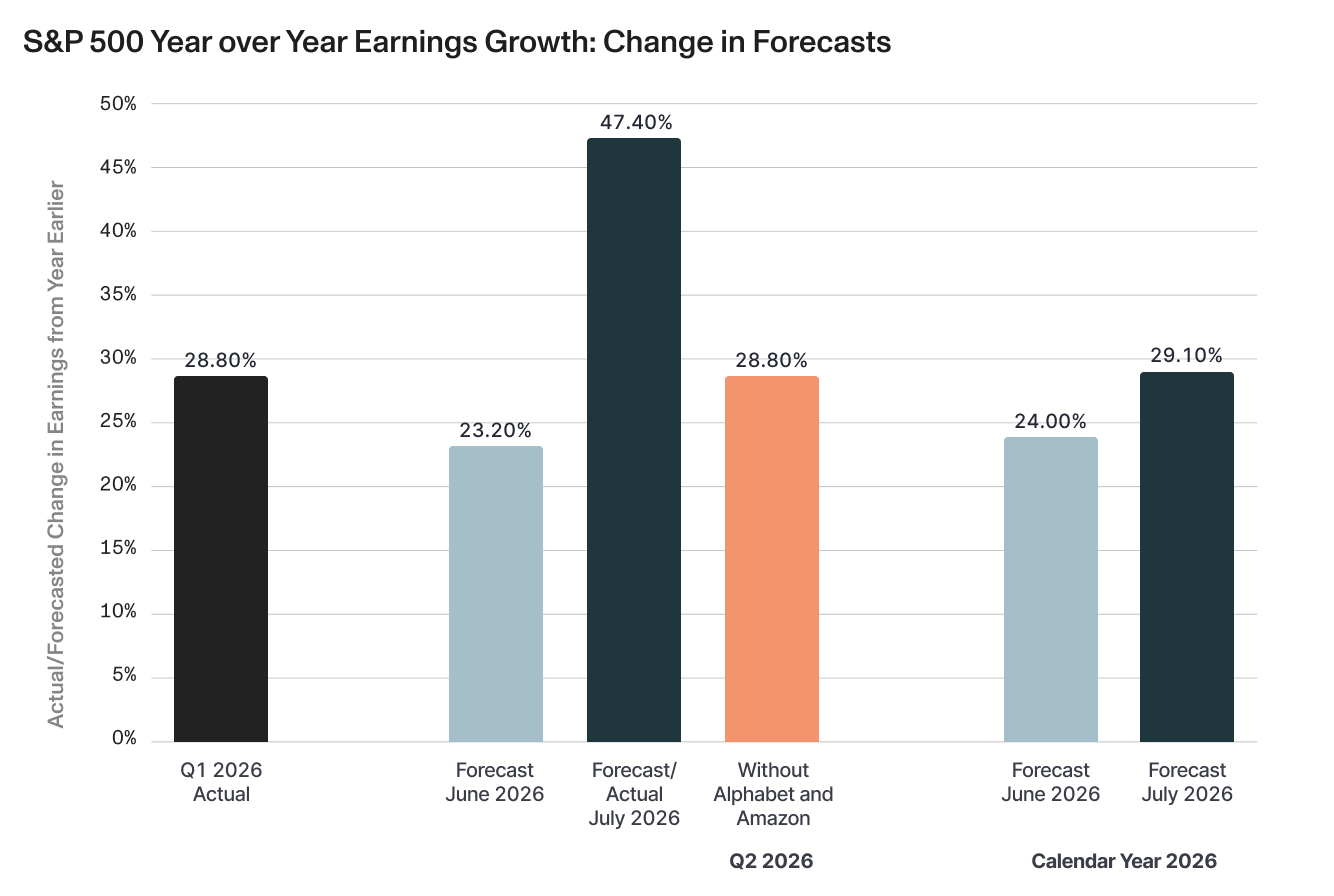
Together, the GDP and earnings data illustrate an important lesson from July. Investors are increasingly looking beyond surface numbers to understand what is driving them. Headline GDP understated the strength of private demand, while reported earnings overstated the contribution from recurring operations. In both cases, the underlying fundamentals remained solid. The hurdle has shifted from asking whether the economy and corporate America remain resilient to understanding how that resilience is being generated. One of the most important questions is whether today's investment-led growth can persist without reigniting inflation. This question sits at the center of the Federal Reserve's challenge.
Sources of Growth — what to watch:
- The pace and breadth of business investment, especially the strength in technology and infrastructure spending.
- Quality of earnings with a focus on operating earnings, margins and cash-flow generation.
- Signs of productivity improvements supporting corporate profitability and non-inflationary growth.
Inflation, Interest Rates & Geopolitical Risk
While June's inflation reports showed encouraging progress because of falling oil and energy prices, geopolitical concerns pushed oil prices higher in early July before easing later in the month as immediate disruptions subsided.29 Although the resulting increase in inflation pressures ultimately proved limited, the episode illustrated how quickly geopolitical events can influence inflation expectations, interest rates and financial markets.
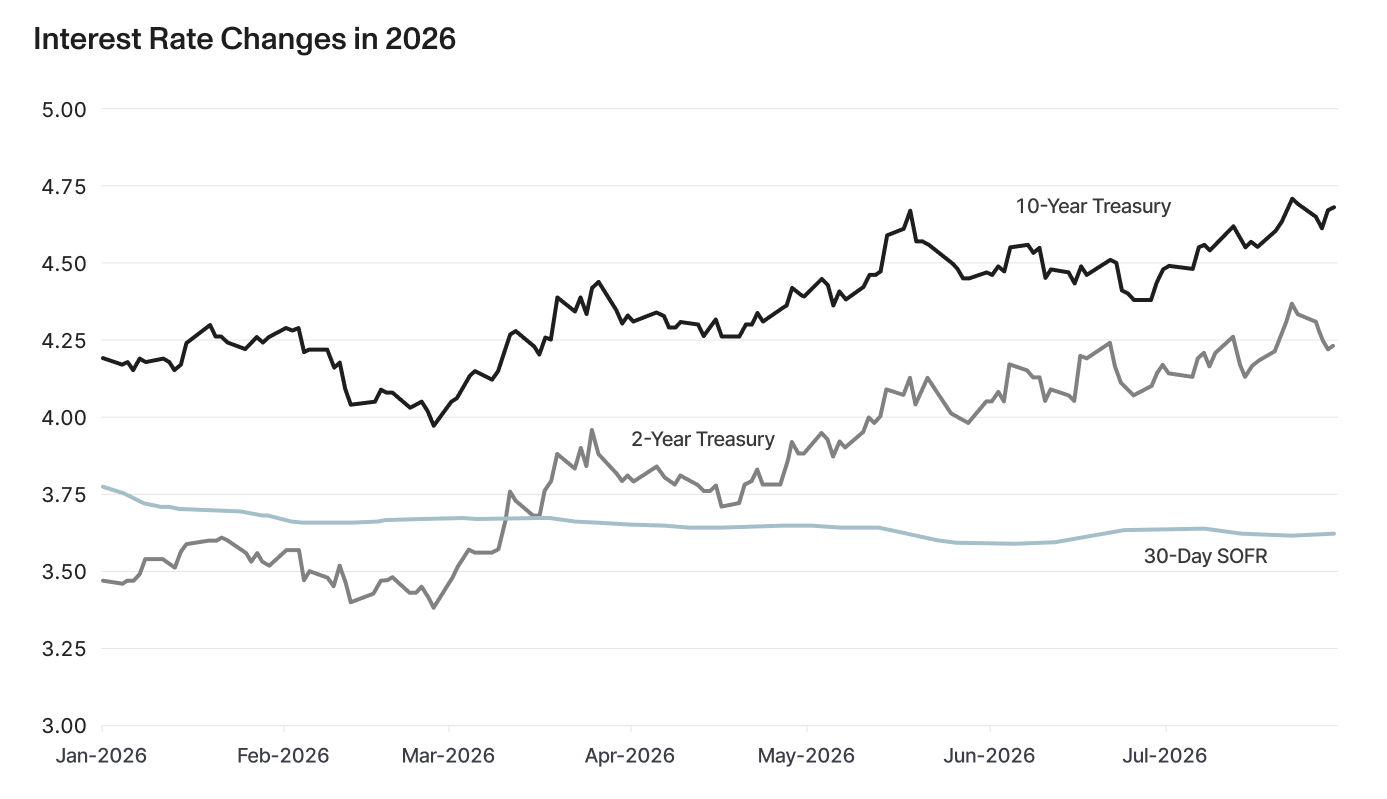
Against that backdrop, interest rates moved higher across much of the Treasury curve.30 Short-term policy rates remained unchanged following the Federal Reserve's July meeting, but both two-year and ten-year Treasury yields increased as investors reassessed the likelihood that interest rates would remain elevated for longer. The move in long rates reflected more than simply changing expectations for Federal Reserve policy. Stronger-than-expected economic data, resilient corporate earnings, continued business investment and concerns over the growing supply of Treasury securities all contributed to higher long-term yields. Together, these developments reinforced the message that financial conditions can tighten even without additional increases in the federal funds rate.
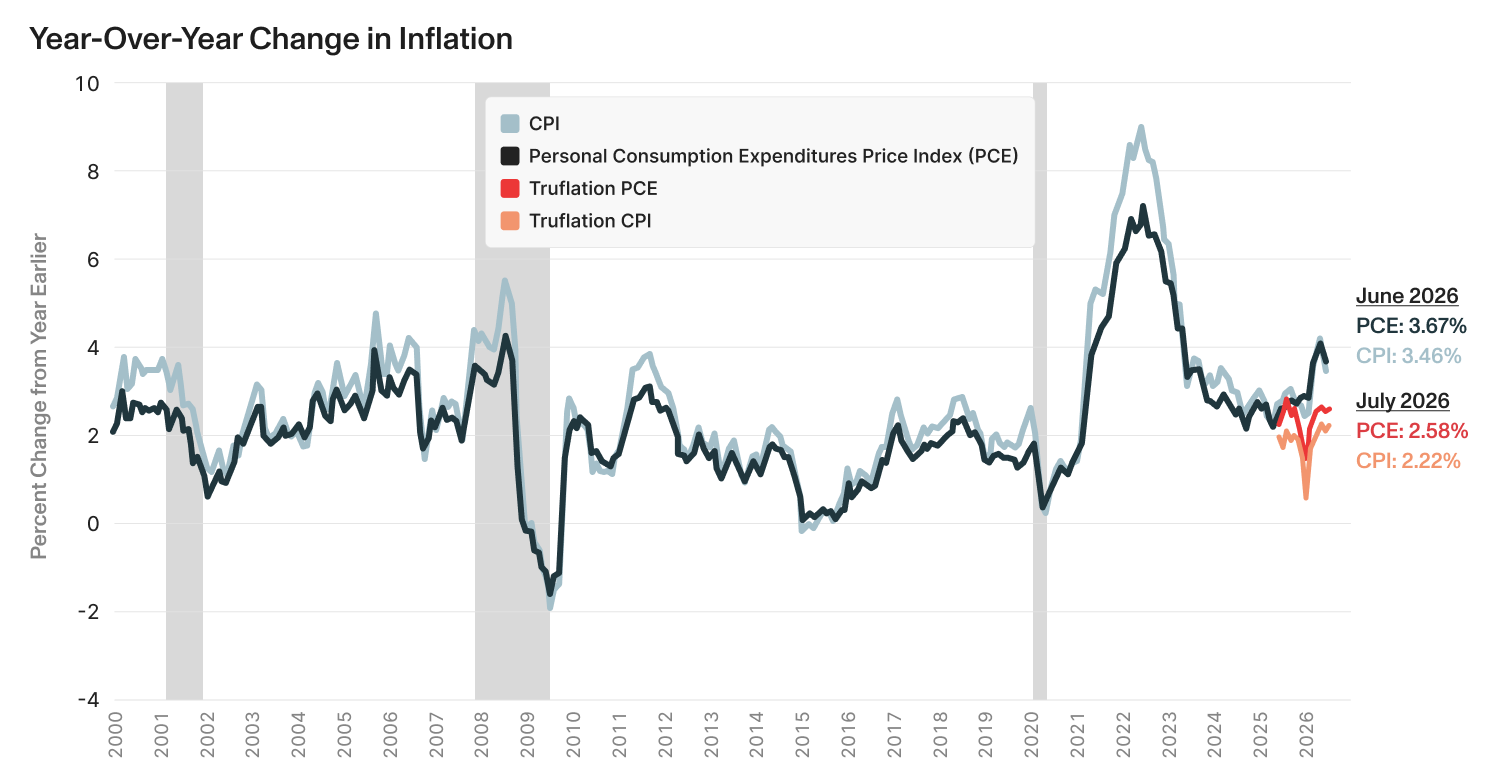
Inflation itself kept moving in the right direction in June, although progress remained uneven. Both CPI and the Federal Reserve's preferred Personal Consumption Expenditures (PCE) measure moderated from the spring's energy-driven increases, while real-time measures such as Truflation also pointed toward easing price pressures later in the month. Even so, inflation remains meaningfully above the Federal Reserve's 2% objective, particularly within labor-intensive service industries where wage growth and persistent demand have supported price increases. Temporary energy price shocks may come and go, but services inflation remains a more important determinant of long-term monetary policy.
The Fed acknowledged the progress on inflation in June while making clear that its work is not yet complete. The FOMC left the federal funds rate unchanged, but three policymakers dissented in favor of another increase, underscoring the growing debate over how restrictive policy should remain.36 Chair Kevin Warsh repeatedly emphasized the Committee's commitment to restoring inflation to its 2% target and signaled a reduced reliance on forward guidance, preferring markets to respond more directly to incoming economic data. As a result, the path of monetary policy became more uncertain, although investors seem increasingly convinced that a rate increase is coming over the rest of the year.37
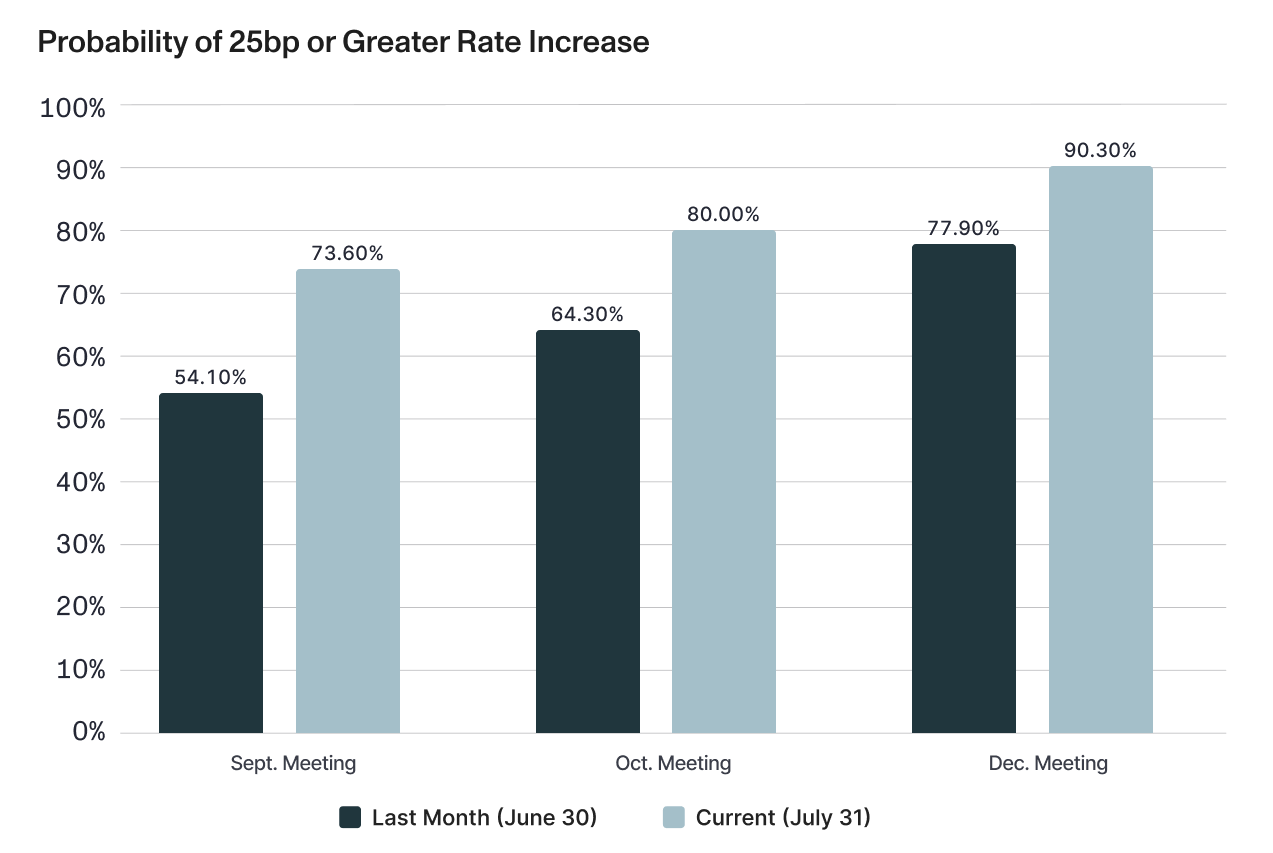
One important takeaway from the July Fed meeting is that investors should focus less on signalling from the Fed and more on the broader direction of inflation and financial conditions. Economic growth has remained resilient, labor markets are cooling gradually rather than abruptly, and businesses are investing heavily in technology and productivity-enhancing assets. Those developments are encouraging, but they also reduce the urgency for policymakers to ease monetary policy quickly. The Federal Reserve no longer needs convincing that inflation is improving—it needs confidence that the improvement will prove durable.
Inflation and Interest Rates — what to watch:
- Progress in core PCE inflation beyond volatile energy prices.
- Interest rate moves at the longer end of the curve.
- Increased disruptions to global energy markets.
AI: The Burden of Proof
Artificial intelligence remained one of the market's defining themes throughout July, but the conversation continued to evolve. Over the past two years, investors have largely focused on whether AI would become a transformative technology and which companies would benefit most from its adoption. Increasingly, however, attention is shifting toward a different question: can the companies making unprecedented investments in AI generate earnings that justify the enormous amount of capital being committed?
That shift was evident throughout the second-quarter earnings season. Several of the largest technology companies have reported exceptional growth in cloud computing and AI-related businesses, reinforcing that demand for AI infrastructure remains strong.39 At the same time, investors also became noticeably more selective. Companies announcing higher capital spending without a similarly compelling path to future earnings were often met with skepticism, while businesses demonstrating measurable revenue growth, improving profitability or stronger customer adoption were rewarded. Markets appear increasingly interested not simply in how much companies are spending, but in what those investments are likely to earn.40
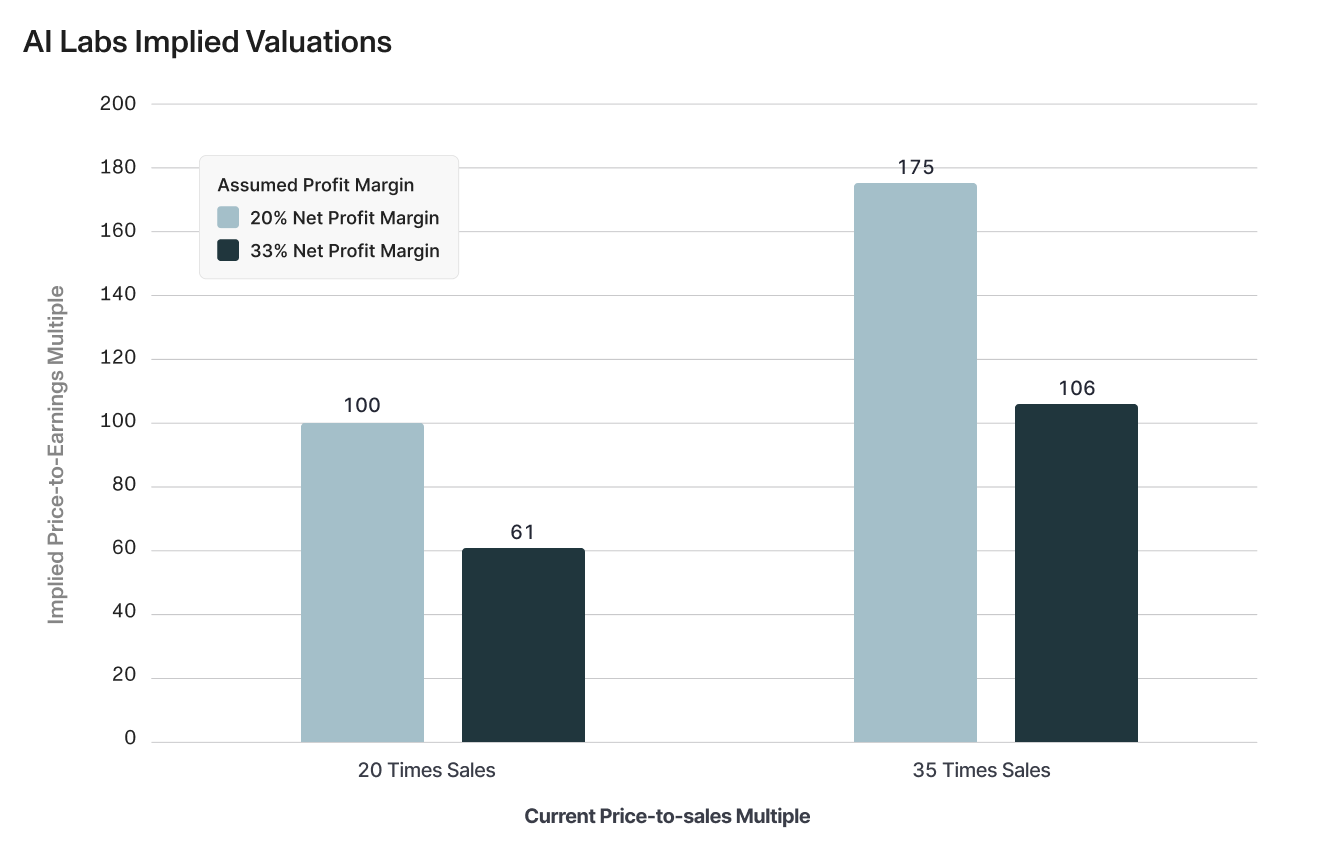
The accompanying chart illustrates why expectations have become such an important part of the discussion. Based on current private-market valuations (using price-to-sales multiples and based on company disclosures, press reports and analyst estimates) and assumptions of 20%–33% future profit margins, several leading still private AI laboratories are priced at levels that imply extraordinarily high profit expectations.41 Those valuations assume not only years of rapid revenue growth, but also profit margins that remain exceptionally strong despite increasing competition, rapidly evolving technology and substantial ongoing investment requirements. In other words, AI does not simply need to transform the economy—it must do so in a way that produces durable economic profits capable of supporting today's valuations.
That does not mean the long-term opportunity has diminished. AI adoption continues accelerating across businesses, while declining computing costs are encouraging broader use of reasoning models, AI agents and increasingly sophisticated applications. As these technologies become more affordable, demand for computing power, networking equipment, semiconductors, electricity and data center infrastructure is likely to further grow.43 Rather than reducing the investment opportunity, lower costs may ultimately expand the number of businesses and industries able to adopt AI at scale.
The investment implications are becoming more nuanced. As AI models become more capable and competition increases—including from open-source and international developers—the greatest economic value may not necessarily accrue to every model developer. Instead, a growing share of the long-term opportunity may reside with companies providing the infrastructure, enterprise software, power generation, networking and other essential services that enable AI adoption across the broader economy.44 45 July's market rotation reflected this distinction, as investors increasingly differentiated between companies promising future AI benefits and those already demonstrating durable earnings, cash flow and competitive advantages.
The history of technological innovation suggests that transformative technologies often create enormous value for society while producing very different outcomes for individual companies. Railroads, the internet and cloud computing each reshaped the economy, but investors ultimately rewarded businesses that developed sustainable competitive advantages and consistently generated attractive returns on capital.46 Artificial intelligence is unlikely to be any different. The long-term opportunity remains compelling, but as expectations rise, markets will increasingly reward companies that can convert innovation into durable profitability rather than growth alone.
AI Investment Cycle — what to watch:
- AI monetization of capital spending into stronger revenue growth, expanding margins and improving free cash flow.
- Competition and pricing pressures making it more difficult for individual model developers to sustain exceptionally high profit margins.
- Infrastructure demand for semiconductors, cloud computing, power generation, networking and data centers boosting broader economic activity.
Looking Ahead:
As the second half of the year begins, the economy still demonstrates remarkable resilience. Business investment remains strong, consumers continue to spend despite growing differences across income groups, and Q2 corporate earnings have thus far exceeded expectations once again. At the same time, inflation remains above the Federal Reserve's target, interest rates are likely to remain restrictive for longer than many investors anticipated at the beginning of the year, and geopolitical developments serve to remind us that the path toward lower inflation is unlikely to be a straight line. Rather than signaling the end of the current expansion, July reinforced that this cycle is becoming increasingly dependent on productivity, disciplined capital allocation and companies' ability to convert investment into sustainable earnings growth.
July’s results suggest that markets are becoming more discerning. Investors are looking beyond headline economic data to the core drivers of growth, beyond earnings surprises to recurring profitability, and beyond AI enthusiasm to the long-term returns those investments are expected to generate. That shift does not diminish the opportunities created by innovation or a resilient economy. Instead, it raises the standard by which companies, industries and investment strategies will be evaluated. As expectations keep rising, the burden of proof requires demonstrating that today's investment decisions can produce tomorrow's durable economic value.
Compound provides everything you need to manage your finances (liquidity planning, concentrated position management, stock option optimization, and more).
[1] https://www.spglobal.com/spdji/en/index-family/equity/
[2] https://www.bea.gov/data/gdp/gross-domestic-product
[3] https://insight.factset.com/topic/earnings
[4] https://www.spglobal.com/spdji/en/index-family/equity/
[5] https://www.spglobal.com/spdji/en/index-family/fixed-income/
[6] https://www.bea.gov/data/personal-consumption-expenditures-price-index
[7] https://www.bls.gov/news.release/cpi.nr0.htm
[8] https://www.bls.gov/news.release/empsit.nr0.htm
[9] https://www.federalreserve.gov/monetarypolicy/fomcpresconf20260729.htm
[10] https://www.spglobal.com/spdji/en/index-family/equity/
[11] https://www.spglobal.com/spdji/en/index-family/equity/us-equity/sp-sectors/
[12] https://www.spglobal.com/spdji/en/index-family/equity/
[13] https://www.msci.com/end-of-day-data-search
[14] https://www.nasdaq.com/market-activity/index/comp/historical
[15] https://www.spglobal.com/spdji/en/index-family/equity/us-equity/sp-sectors/
[16] https://www.spglobal.com/spdji/en/index-family/fixed-income/
[17] https://ionanalytics.com/insights/mergermarket/ma-highlights-1h26/
[18] https://www.kkr.com/insights/investment-playbook
[19] https://www.institutionalinvestor.com/article/more-1-trillion-stuck-zombie-private-equity-funds
[20] https://www.morganstanley.com/im/en-us/individual-investor/insights/outlooks/private-credit-midyear-outlook-2026.html
[21] https://www.morganstanley.com/im/en-gr/institutional-investor/insights/outlooks/real-estate-midyear-outlook-2026.html
[22] https://www.bea.gov/data/gdp/gross-domestic-product
[23] https://www.bea.gov/data/gdp/gross-domestic-product
[24] https://www.bea.gov/data/gdp/gross-domestic-product
[25] https://www.kkr.com/insights/mid-year-update-2026
[26] https://www.kkr.com/insights/mid-year-update-2026
[27] https://insight.factset.com/topic/earnings
[28] https://insight.factset.com/topic/earnings
[29] https://www.eia.gov/dnav/pet/pet_pri_spt_s1_d.htm
[30] https://www.federalreserve.gov/releases/h15/
[31] https://www.federalreserve.gov/releases/h15/
[32] https://www.newyorkfed.org/markets/reference-rates/sofr-averages-and-index
[33] https://www.bea.gov/data/personal-consumption-expenditures-price-index
[34] https://www.bls.gov/news.release/cpi.nr0.htm
[35] https://truflation.com/indexes/atlas-inflation
[36] https://www.federalreserve.gov/monetarypolicy/fomcpresconf20260729.htm
[37] https://www.cmegroup.com/markets/interest-rates/cme-fedwatch-tool.html
[38] https://www.cmegroup.com/markets/interest-rates/cme-fedwatch-tool.html
[39] https://insight.factset.com/topic/earnings
[40] Alpine Macro, AI Competition, Compute Scarcity, and the Repricing of Intelligence, July 2026
[41] https://www.researchaffiliates.com/insights/publications/articles/1122-moat-or-mirage-the-arithmetic-of-ai-lab-valuations
[42] https://www.researchaffiliates.com/insights/publications/articles/1122-moat-or-mirage-the-arithmetic-of-ai-lab-valuations
[43] https://www.morganstanley.com/im/en-us/financial-advisor/insights/outlooks/infrastructure-midyear-outlook-2026.html
[44] https://www.morganstanley.com/im/en-us/financial-advisor/insights/outlooks/infrastructure-midyear-outlook-2026.html
[45] Alpine Macro, AI Competition, Compute Scarcity, and the Repricing of Intelligence, July 2026
[46] https://www.kkr.com/insights/mid-year-update-2026