
Competing for Capital

Compound is a digital family office for entrepreneurs, professionals, and retirees who want the personal touch of a dedicated advisor accompanied by a beautiful digital experience.
August provided stronger evidence that the forces supporting markets extend beyond investor optimism. Corporate earnings substantially exceeded expectations, with growth broadening beyond the largest technology companies, and AI-related revenues continued to expand alongside unprecedented investment in the infrastructure needed to support them. Equity markets moved higher against that backdrop as gains extended across several sectors and international markets even as performance remained uneven beneath the surface.
The strength in fundamentals is occurring in a considerably more demanding capital environment. Inflation remains above the Federal Reserve’s target, interest rates remain relatively high, and government borrowing and AI infrastructure are creating enormous financing needs. That combination is raising the importance of not only how quickly companies and the economy can grow, but also how that growth is financed and what returns it ultimately produces.
August 2026 at a glance
- Economy: Economic growth continued to moderate without signaling a broad contraction, but weakness in housing and consumer spending highlighted greater sensitivity to higher borrowing costs.1 2
- Earnings: Corporate earnings substantially exceeded expectations in the second quarter, with strength extending well beyond the largest technology companies.3
- Inflation, Employment and the Fed: Inflation remained above the Fed’s target despite some signs of improvement, while the labor market continued to cool.4 5 Chair Warsh reinforced the Fed’s focus on price stability in August, keeping the possibility of additional tightening in play.6
- Equity Markets: Stocks advanced as strong corporate earnings and continued AI investment supported markets, while leadership extended beyond the largest technology companies.7
- Fixed Income: Bond markets balanced softer economic and labor-market data against persistent inflation and a more hawkish Federal Reserve.8
- Private Markets: Activity and liquidity continued to improve unevenly across private markets, while differences among individual companies and investments became more important.
- Artificial Intelligence: AI-related demand and revenues continued to grow alongside extraordinary investment in data centers and computing infrastructure. The next test is whether those revenues and cash flows can generate attractive returns on the enormous amount of capital being deployed.
- Midterm Elections: November’s elections are likely to increase political and policy uncertainty, but their investment implications will depend less on which party wins than on whether resulting policy changes materially affect fundamentals.
- Geopolitics: Global conflicts remained an important source of uncertainty, particularly through their potential effects on energy prices, trade and inflation, even as markets remained relatively resilient.
Stocks
Stocks moved higher in August, supported by strong corporate earnings and continued optimism around artificial intelligence. The S&P 500 gained 2.7% during the month, while the technology-heavy Nasdaq Composite rose 4.0%. Emerging markets and international small-cap stocks also performed well, while U.S. small caps lagged, particularly growth-oriented companies.9
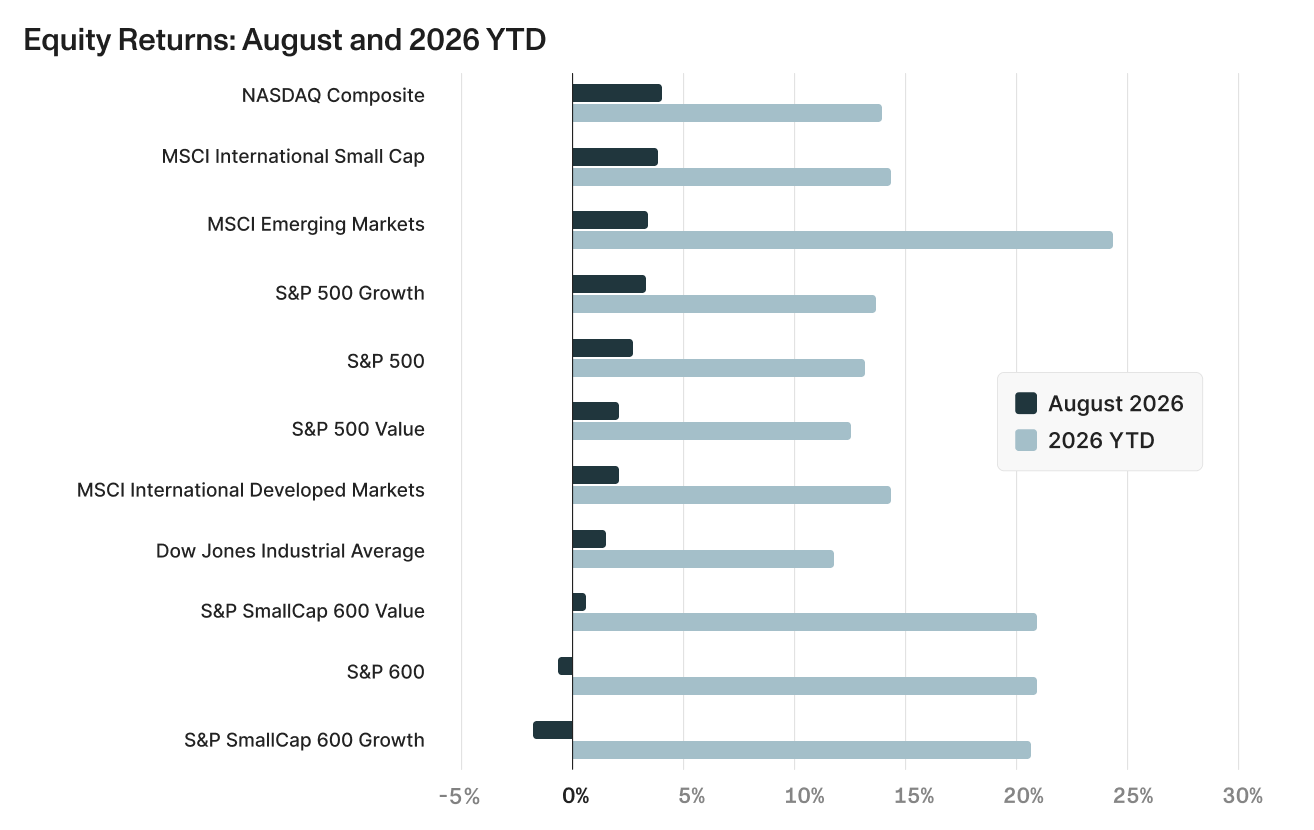
Market leadership was broader than the headline strength in technology might suggest. Energy was the strongest-performing S&P 500 sector in August, followed by Information Technology and Materials, while Health Care also outperformed the broader market. At the same time, Utilities, Industrials, and Real Estate declined.
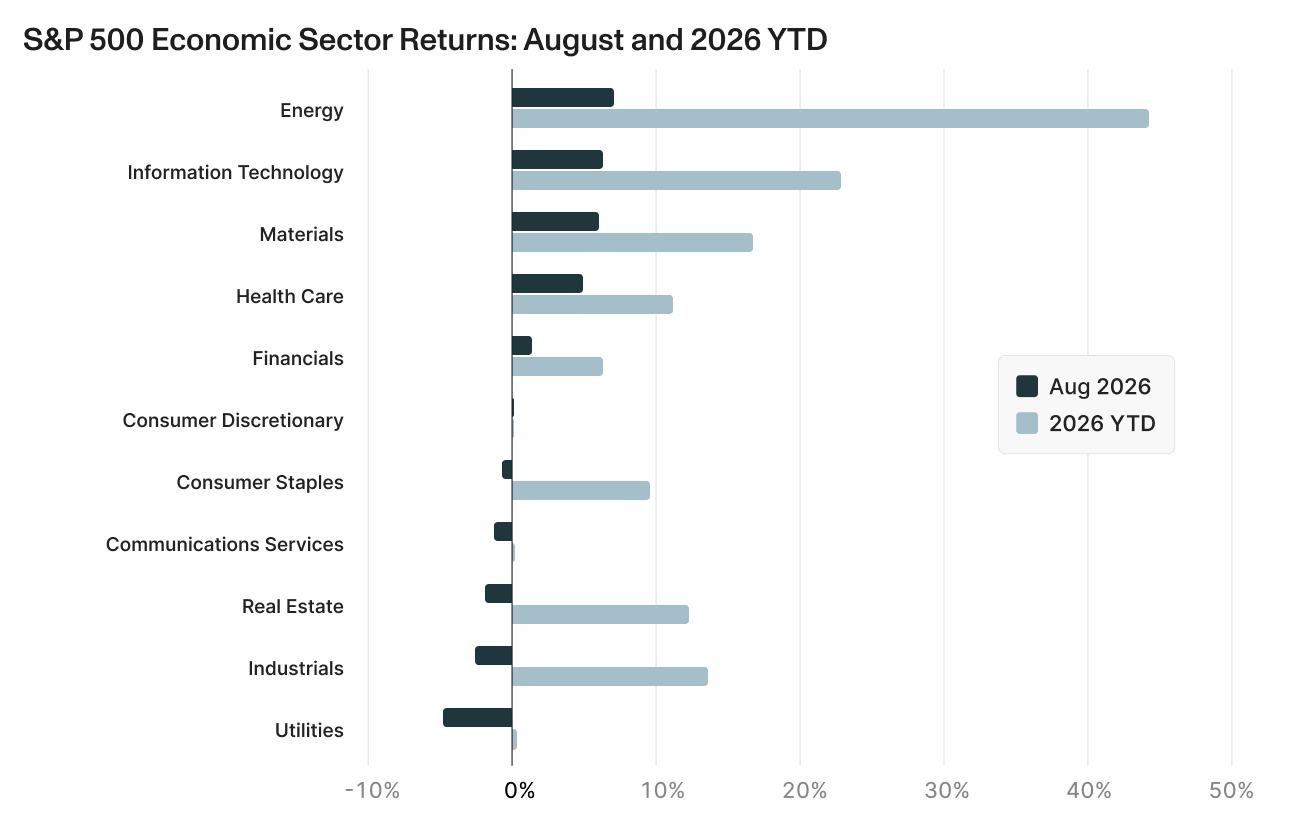
The equity sector picture is more positive when looking at the year as a whole. Seven of the 11 sectors now show returns of 10% or more so far in 2026. Energy has been the strongest sector, reflecting the rise in oil prices, while emerging markets, technology, and small-cap stocks have also generated strong year-to-date returns. After several years of unusually narrow leadership, the range of sectors participating in this year’s gains has broadened considerably.
Fixed Income
Bond markets posted modest gains in August, but the interest-rate environment became more complicated.14 Slower economic growth and a cooling labor market would ordinarily put downward pressure on yields, but inflation remains above the Federal Reserve’s target and Chair Warsh reinforced the Fed’s focus on price stability late in the month.15 Longer-term yields are also being influenced by elevated real rates and heavy borrowing needs from both the government and private sector, including AI infrastructure.
High-yield bonds and preferred stocks led during the month, while core investment-grade bonds and Treasuries generated smaller positive returns. Municipal bonds were the only sector to post negative returns for the month. Despite August’s gains, most core bond categories remain roughly flat for the year as higher long-term interest rates have offset much of the income investors have earned.
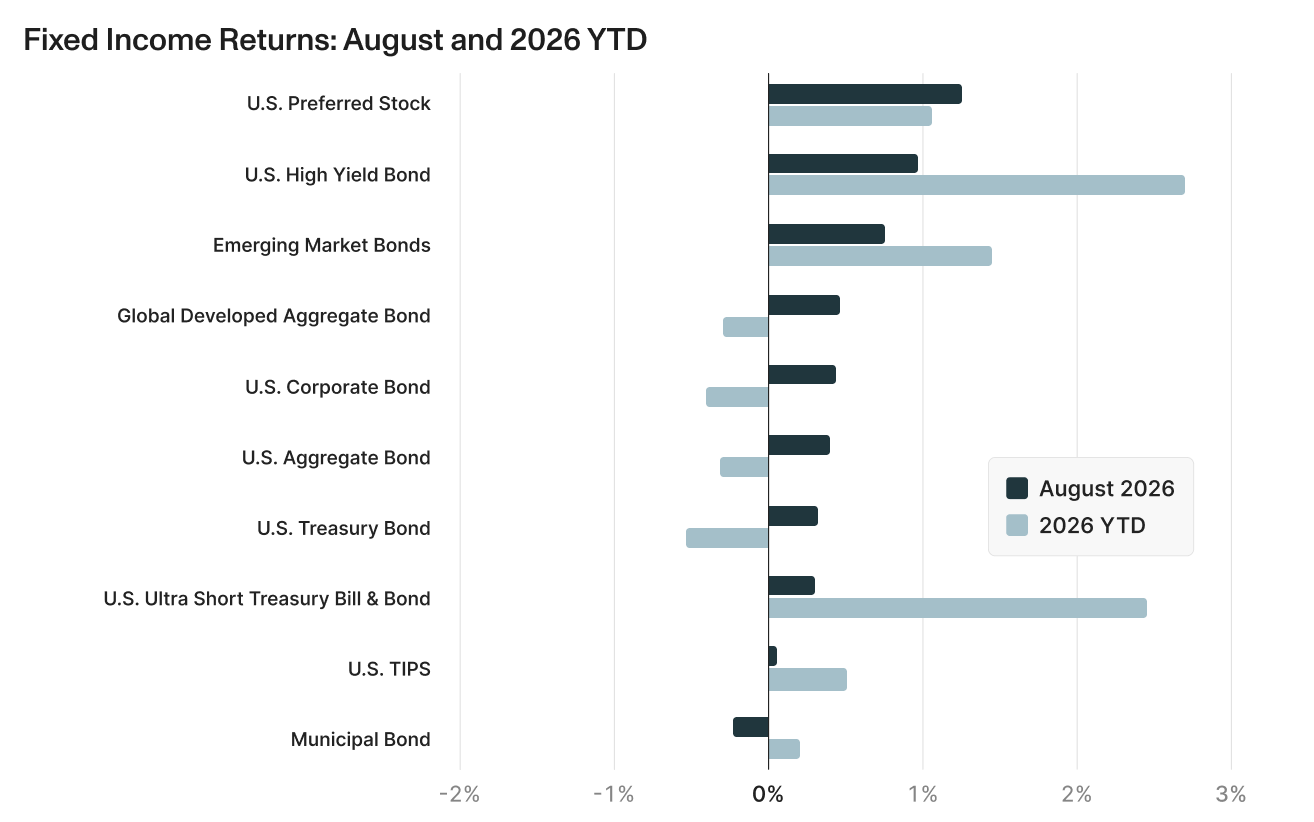
For investors, higher starting yields mean bonds can generate considerably more income than they did during much of the prior decade. At the same time, their relationship with stocks has begun to change again after several years in which inflation shocks frequently pushed both asset classes in the same direction. We explore that shift in greater detail below.
Private Markets
Private equity and venture markets continued to recover in August. Deal and exit activity have moved higher from the lows of the past several years, but significant amounts of capital remain tied up in older funds. The secondary market continues to grow in response, evolving from primarily a source of liquidity for investors that need to sell into a broader portfolio-management tool for both investors and fund managers.17
Private credit conditions remain healthy and defaults relatively contained, but stress is becoming more visible among weaker borrowers, particularly highly leveraged software companies facing potential disruption from artificial intelligence.18 Payment-in-kind income and non-accruals remain important indicators of stress in parts of the market. After years of rapid growth in private lending, underwriting and manager selection are becoming more important.19
Private real estate and real assets are becoming more connected to the AI investment cycle. The enormous buildout of data centers is driving demand not only for computing equipment but also for power generation, transmission, electrical equipment, construction, and industrial real estate.20 21 This creates potential opportunities across infrastructure and real estate as the AI buildout becomes as much a physical infrastructure and capital-allocation story as a technology story.
Looking Beneath the Headlines
Earnings, AI and the Return on Capital
Corporate earnings provided one of the strongest fundamental supports for markets in August. With nearly all S&P 500 companies having reported second-quarter results, earnings grew 52% from a year earlier, more than double the 23% growth expected at the end of June.22 That headline figure was boosted substantially by investment gains at Alphabet and Amazon, but the underlying results were still impressive. Excluding those gains, S&P 500 earnings grew nearly 34%, while the 493 companies outside the Magnificent Seven grew almost 32%.
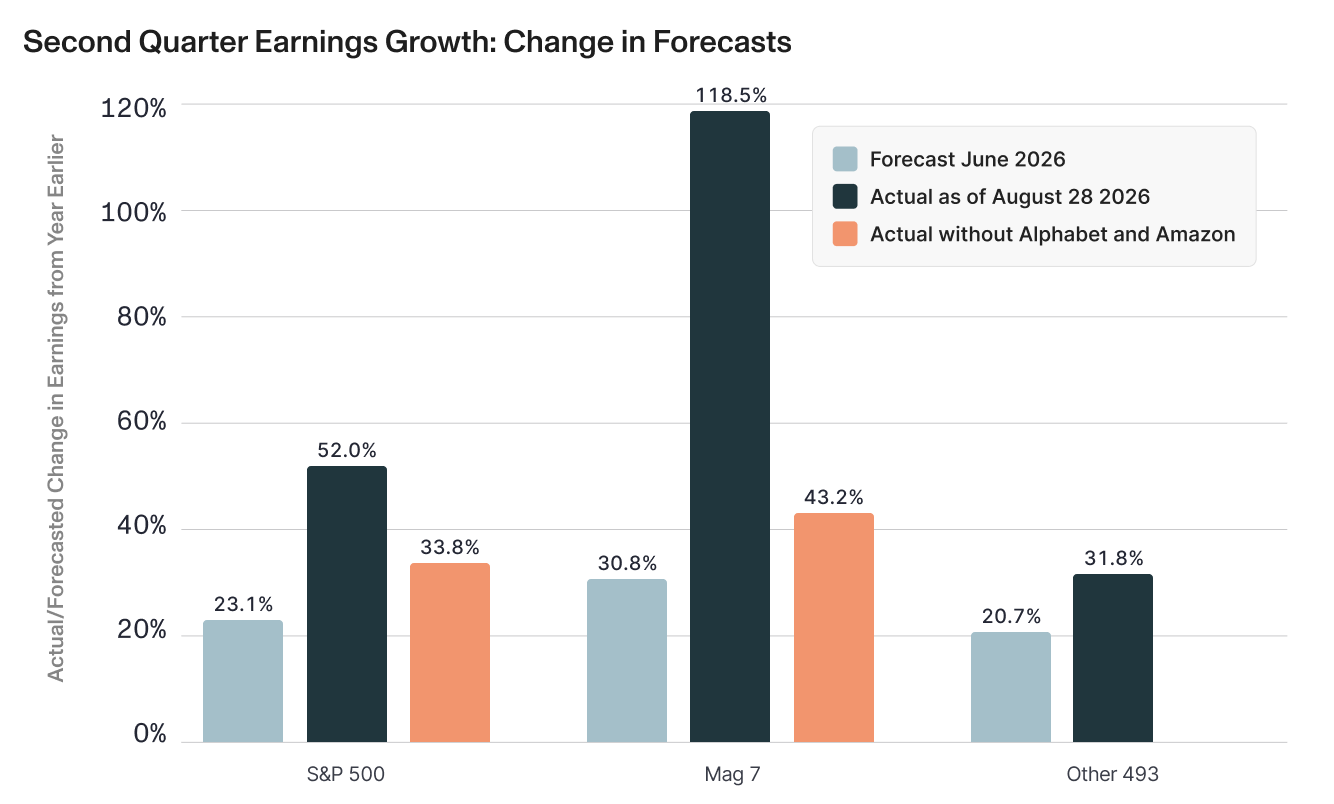
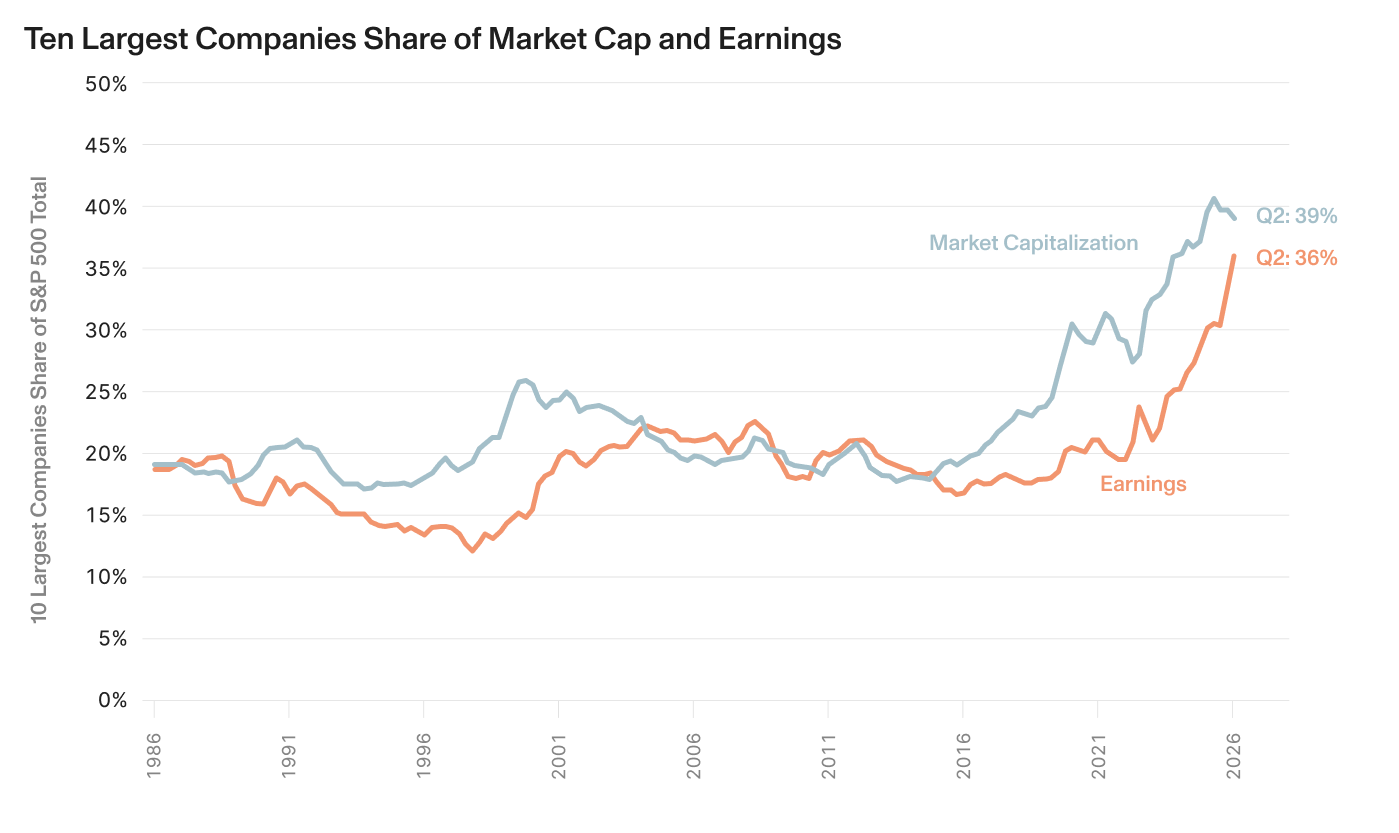
The broadening in earnings growth is encouraging, but the market still remains highly concentrated. The ten largest companies now represent roughly 39% of the S&P 500's market capitalization, near a historical high.24 Yet their share of the index's earnings has also risen sharply, reaching roughly 36% currently. Importantly, the gap between their share of market capitalization and earnings has narrowed considerably. Today's market concentration is therefore supported more by earnings than it was earlier in the cycle. That does not make concentration irrelevant to overall market performance, but it provides stronger fundamental support for their market weights than existed earlier in the cycle.
Artificial intelligence has been central to that earnings growth, but it is also requiring an extraordinary amount of investment to sustain it. The largest hyperscalers are spending hundreds of billions of dollars annually on data centers, semiconductors, networking equipment, and power infrastructure. Importantly, revenues associated with that investment are also growing. Estimates suggest hyperscaler capital expenditures relative to AI revenue could peak around 2027 at close to 100% and then decline meaningfully as revenues catch up with the infrastructure buildout.26

The evidence suggests that AI demand is real and that the investment is already contributing to revenue and earnings growth. But demonstrating demand is not the same as demonstrating an attractive return on every dollar invested. As spending grows, utilization, pricing, margins and financing costs will matter more. The dividing line may be less about whether AI succeeds and more about which companies ultimately earn adequate returns on the capital required to build it.
Earnings, AI and the Return on Capital — what to watch:
Earnings breadth: Whether growth continues expanding beyond the largest technology companies.
AI monetization: Whether AI-related revenue keeps pace with rapidly rising investment.
Returns on capital: Whether higher utilization and margins translate into stronger cash flows as spending grows.
Inflation, the Fed and Stock-Bond Dynamics
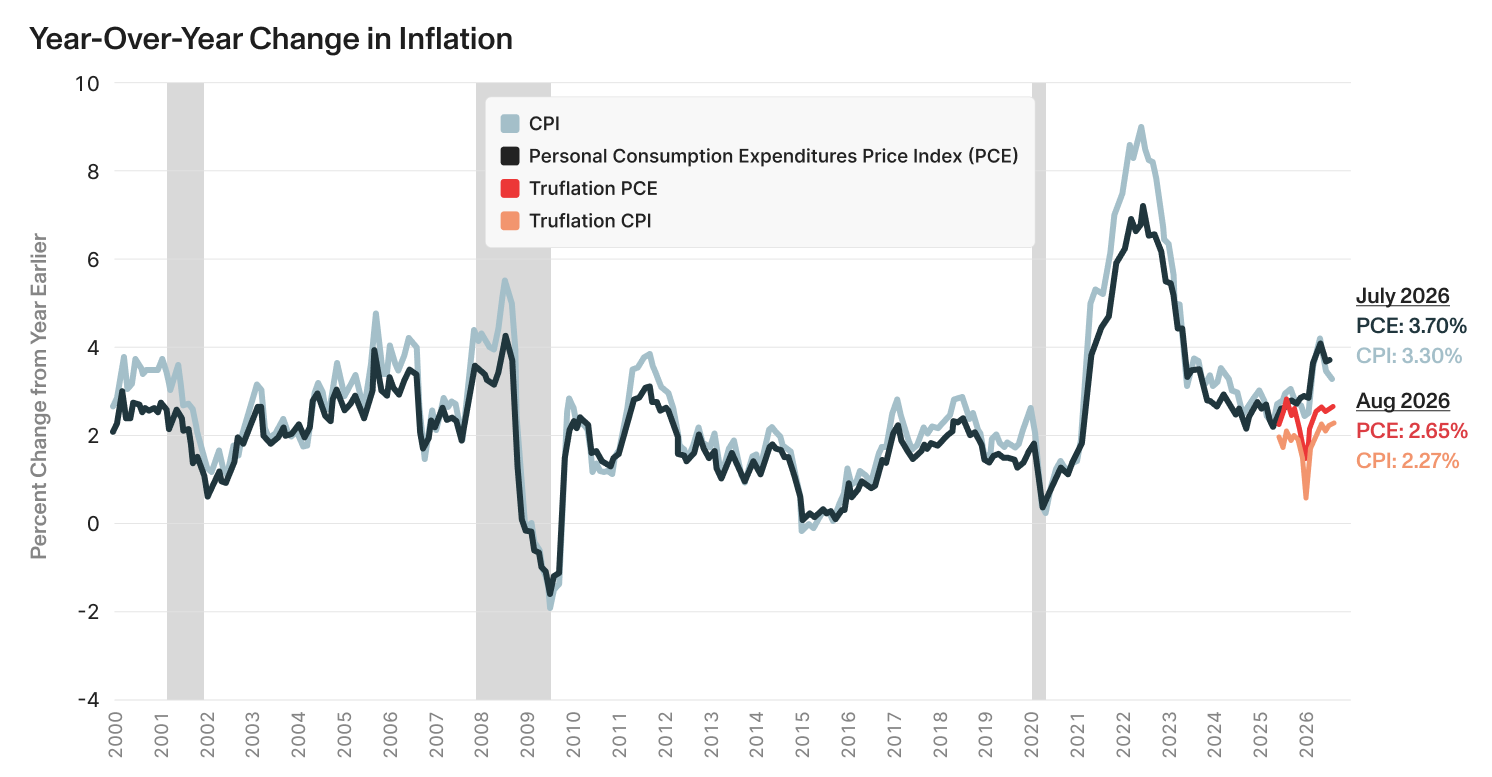
Inflation trends remained mixed in August. The Fed’s preferred PCE measure remained well above its 2% target, with headline inflation at 3.7% and core inflation at 3.3%.28 Higher-frequency measures from Truflation pointed to considerably softer inflation, while recent government data also showed some improvement beneath the headline figures.29 The divergence reinforces the uncertainty facing policymakers: inflation has eased substantially from its 2022 peak, but the evidence is not yet strong enough for the Fed to conclude that price pressures have returned sustainably to target.
That uncertainty was central to Chair Kevin Warsh’s message at Jackson Hole.30 Despite signs of softer hiring and slower economic growth, Warsh emphasized that inflation remains too high and that the Fed would remain focused on price stability rather than committing in advance to its next policy move. Markets responded by increasing the probability of another rate increase.31 The tension between cooling labor conditions and above-target inflation leaves monetary policy unusually dependent on incoming data and the direction of inflation particularly important for both stocks and bonds.
One consequence of the inflation shocks of the past several years has been a changing relationship between stocks and bonds. For much of the 2010s, economic weakness tended to hurt stocks while pushing interest rates lower and bond prices higher. Inflation spikes disrupted that relationship. When inflation became the dominant risk, the same surprise could simultaneously pressure stock valuations and push bond yields higher, causing both asset classes to fall together.
More recently, that relationship has begun to reverse. Stock-bond correlation has fallen sharply over the past year and has turned negative since April. The shift is consistent with a market in which growth and earnings are beginning to matter more relative to inflation shocks, although several months of data are too little to establish a new regime. If sustained, a negative correlation would improve the diversification characteristics of traditional stock-and-bond portfolios, particularly now that bonds also offer substantially more income than they did during the low-rate era.

Still, with inflation remaining above target and long-term yields sensitive to fiscal and supply concerns, inflation pressure could once again cause stocks and bonds to move together. For long-term investors, it is helpful that higher bond yields are now being accompanied by early signs that bonds may once again provide both income and diversification.
Inflation, the Fed and Stock-Bond Dynamics — what to watch:
Inflation: Whether government and higher-frequency measures continue to converge lower.
Fed policy: How policymakers balance persistent inflation against a cooling labor market.
Stock-bond correlation: Whether the recent return to negative correlation persists.
Midterm Elections: Fundamentals Over Politics
With the November midterm elections approaching, political uncertainty is likely to receive more attention from investors. Historically, market volatility and policy uncertainty have often increased ahead of midterm elections, but election outcomes themselves have been much less reliable guides to subsequent market performance. This year may be another example. While control of Congress could change, the fundamental earnings and inflation forces currently driving markets are unlikely to turn on the election result.
Where the midterms could matter more is through policy. A change in congressional control could increase the likelihood of divided government and constrain major legislation, impacting areas such as healthcare, taxes, government spending, and regulatory oversight. At the same time, things like tariffs, immigration, regulation, and foreign policy remain substantially influenced by the executive branch. Fiscal pressures are also unlikely to disappear under either party, leaving government borrowing and the cost of financing as longer-term market considerations regardless of the election results.
For investors, the distinction is useful. Rather than trying to predict which election outcome markets will prefer, the more relevant question is what policies could actually change after November, and whether those changes are significant enough to alter the economic or earnings outlook.
Midterm Elections — what to watch:
Congressional control: Whether the election produces a divided government.
Policy changes: Potential implications for taxes, spending, regulation, and healthcare.
Market fundamentals: Whether election-related policy changes alter the outlook for growth, inflation, or earnings.
Looking Ahead:
August's developments point to a market in which strong fundamentals and a more demanding capital environment increasingly coexist. Earnings have substantially exceeded expectations and AI-related revenues continue to grow, but relatively high interest rates and enormous financing needs are raising the hurdle for new investment.
That combination makes the quality of growth especially important. For AI investments, the question is no longer simply whether companies can generate revenue from artificial intelligence, but whether that revenue can justify the capital required to produce it. Similar distinctions are becoming more important across markets, from private credit, where stress remains concentrated among weaker borrowers, to public equities, where broader participation is occurring alongside historically high index concentration. For long-term investors, this environment favors focusing less on predicting the next Fed move or political turning point and more on the fundamentals like earnings, cash flows, and valuations that determine outcomes over time. Higher capital costs leave less room for disappointment and raise the hurdle that new investments ultimately need to clear.
Compound provides everything you need to manage your finances (liquidity planning, concentrated position management, stock option optimization, and more).
[1] https://www.census.gov/construction/nrc/current/index.html
[2] https://www.bea.gov/data/consumer-spending/main
[3] https://insight.factset.com/topic/earnings
[4] https://www.bls.gov/news.release/cpi.nr0.htm
[5] https://www.bea.gov/data/personal-consumption-expenditures-price-index
[6] https://www.federalreserve.gov/newsevents/speech/warsh20260828a.htm
[7] https://www.spglobal.com/spdji/en/index-family/equity/
[8] https://www.spglobal.com/spdji/en/index-family/fixed-income
[9] https://www.spglobal.com/spdji/en/index-family/equity/
[10] https://www.spglobal.com/spdji/en/index-family/equity/
[11] https://www.msci.com/end-of-day-data-search
[12] https://www.nasdaq.com/market-activity/index/comp/historical
[13] https://spglobal.com/spdji/en/index-family/equity/us-equity/sp-sectors/
[14] https://www.spglobal.com/spdji/en/index-family/fixed-income/
[15] https://www.federalreserve.gov/newsevents/speech/warsh20260828a.htm
[16] https://www.spglobal.com/spdji/en/index-family/fixed-income/
[17] https://www.harbourvest.com/us/en/insights/market-outlooks/2026/2026-mid-year-private-markets-outlook
[18] https://www.apollo.com/wealth/insights-news/insights/2026/08/2026-midyear-credit-outlook
[19] https://www.morganstanley.com/im/en-us/individual-investor/insights/outlooks/private-credit-midyear-outlook-2026.html
[20] https://www.apollo.com/wealth/insights-news/insights/2026/08/2026-midyear-credit-outlook
[21] https://www.harbourvest.com/us/en/insights/market-outlooks/2026/2026-mid-year-private-markets-outlook
[22] https://insight.factset.com/mag-7-companies-reported-earnings-growth-above-100-boosted-by-investment-gains
[23] https://insight.factset.com/mag-7-companies-reported-earnings-growth-above-100-boosted-by-investment-gains
[24] Goldman Sachs, Weekly Market Monitor, August 28, 2026.
[25] Goldman Sachs, Weekly Market Monitor, August 28, 2026.
[26] Alpine Macro, “Debunking AI Bears: Money for Nothing, Chips for Free?”, August 25, 2026
[27] Alpine Macro, “Debunking AI Bears: Money for Nothing, Chips for Free?”, August 25, 2026.
[28] https://www.bea.gov/data/personal-consumption-expenditures-price-index
[29] https://truflation.com/indexes?tags=Inflation
[30] https://www.federalreserve.gov/newsevents/speech/warsh20260828a.htm
[31] https://www.cmegroup.com/markets/interest-rates/cme-fedwatch-tool.html
[32] https://www.bea.gov/data/personal-consumption-expenditures-price-index
[33] https://www.bls.gov/news.release/cpi.nr0.htm
[34] https://truflation.com/indexes?tags=Inflation
[35] https://fred.stlouisfed.org/series/SP500
[36] https://fred.stlouisfed.org/series/DGS10