
Raising the Bar

Compound is a digital family office for entrepreneurs, professionals, and retirees who want the personal touch of a dedicated advisor accompanied by a beautiful digital experience.
Financial markets entered the third quarter supported by strong economic growth, accelerating corporate earnings, and continued enthusiasm around artificial intelligence. Those fundamentals remained largely intact through September, but the investment environment became more demanding. The Federal Reserve raised interest rates for the first time since 2023, Treasury yields moved sharply higher, and equity market leadership narrowed even as earnings expectations continued to improve and broaden. By quarter-end, investors were confronting a combination of stronger growth and earnings alongside a significantly higher cost of capital.
That combination raises the bar across financial markets. Higher real interest rates increase the returns investors require from stocks, bonds, and private investments, while the enormous financing needs associated with government borrowing and the AI infrastructure buildout are increasing competition for capital. So far this year, economic growth and corporate profits have been strong enough to absorb those pressures, but the dispersion beneath headline market returns suggests investors are becoming more selective. The question heading into the fourth quarter is not simply how robustly the economy and companies can grow, but how efficiently that growth is financed and what returns it ultimately produces.
September and Q3 2026 at a glance
- Economic Growth: Economic growth remained stronger than consumer sentiment suggested. Second-quarter GDP was revised higher, while consumer spending and business investment remained solid heading into Q4, even as hiring slowed.
- Earnings: Corporate earnings continued to provide a strong foundation for markets. S&P 500 earnings expectations were revised meaningfully higher during the quarter, with technology and AI-related companies continuing to lead growth.
- Equity Markets: The S&P 500 rose modestly during Q3, but headline returns masked a significant narrowing in market leadership. Large-cap growth and technology outperformed while small-cap stocks declined sharply and seven of eleven S&P 500 sectors finished the quarter lower.
- Fixed Income: Bonds came under broad pressure as Treasury yields rose across the curve. The U.S. Aggregate Bond Index declined sharply during Q3, illustrating the tradeoff between short-term price declines and attractive future income.
- Inflation and Employment: Inflation remained above the Federal Reserve's target, although core inflation moderated late in the quarter. Hiring also slowed sharply in September, while unemployment remained relatively low at 4.2%.
- Federal Reserve: The Fed raised its policy rate by 25 basis points in September, its first increase since 2023, as strong growth and persistent inflation kept pressure on policymakers. Softer inflation and employment data subsequently reduced expectations for another immediate increase.
- Artificial Intelligence: AI demand and earnings continued to strengthen, but the investment story is shifting from growth to financing. Rising capital expenditures and greater use of debt markets are raising the importance of the cash flows and returns ultimately generated by AI investment.
- Geopolitics and Policy: Geopolitical developments continued to influence energy prices, inflation, and interest rates. With the U.S. midterm elections approaching, potential changes in fiscal, tax, trade, regulatory, and energy policy are also moving further into investors' focus.
Stocks
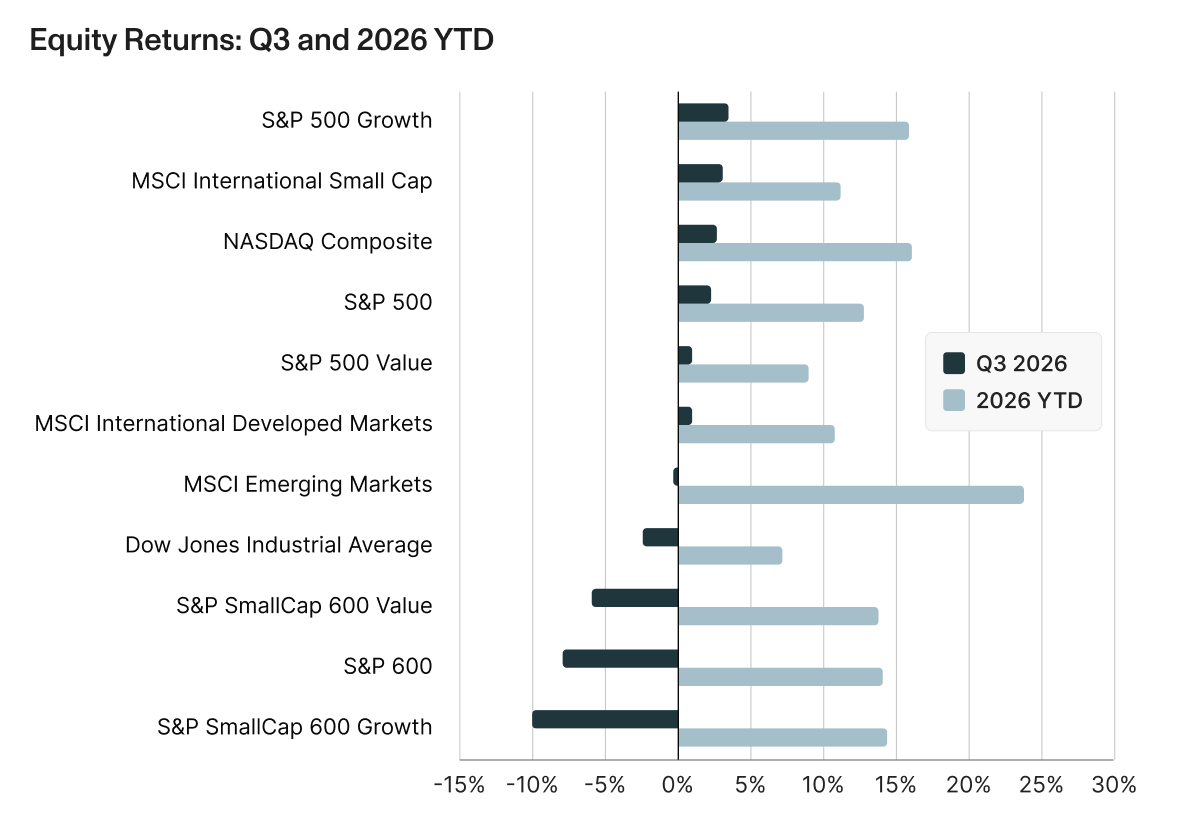
Stocks delivered mixed results during the third quarter, with headline index returns masking a significant narrowing in market leadership. The S&P 500 gained 2.3% during Q3 despite declining 0.3% in September, while the Nasdaq gained 2.6%. Large-cap growth remained the strongest part of the U.S. market, gaining 3.4% for the quarter and nearly 16% year to date. In contrast, the S&P SmallCap 600 declined 7.9% during Q3, including a 5.6% decline in September.10
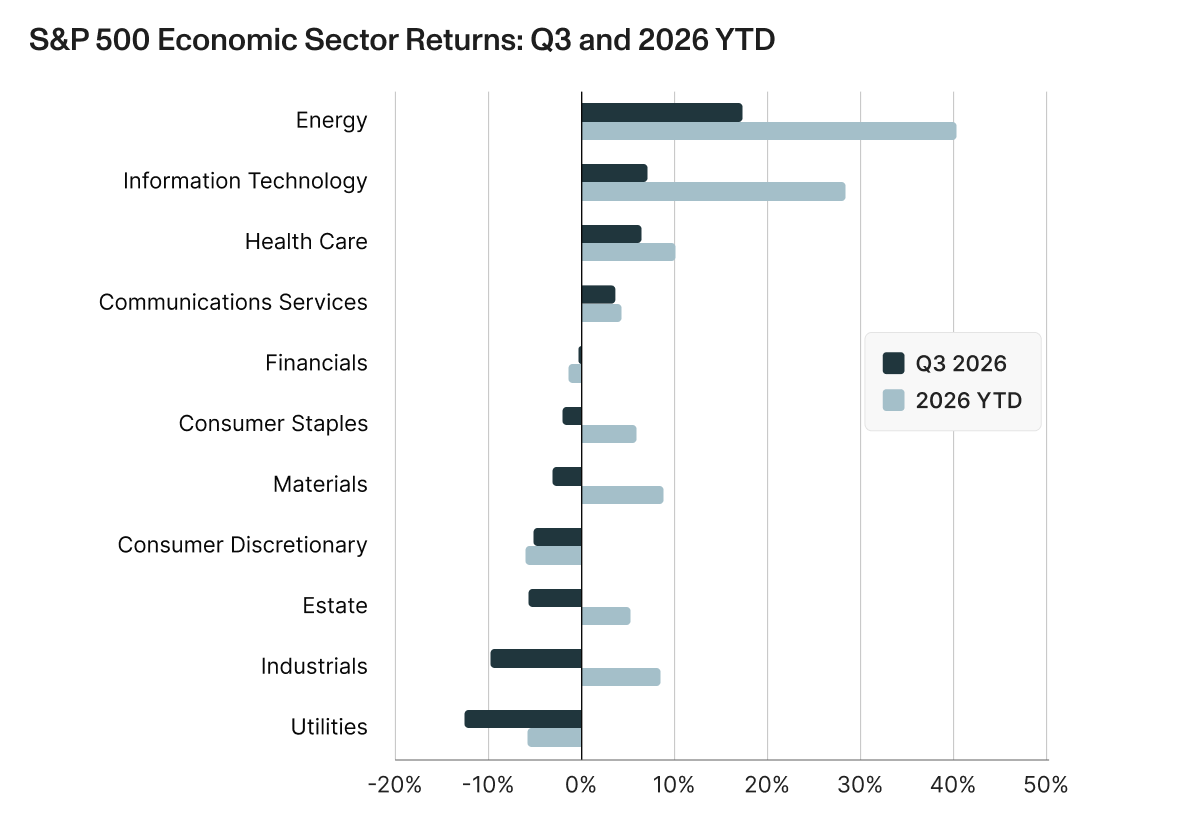
The divergence was even more apparent beneath the index level. Seven of the eleven S&P 500 sectors declined during Q3. Energy was the clear leader, gaining 17.2%, followed by Information Technology at 7.2% and Health Care at 6.5%. Utilities declined 12.4% and Industrials fell 9.7%. Leadership narrowed further in September, when Information Technology and Communication Services were the only two sectors to post positive returns.
The narrowing in market leadership occurred even as the fundamental backdrop for corporate profits continued to improve. S&P 500 earnings estimates rose during the quarter rather than following their typical intra-quarter pattern of downward revisions, and all eleven sectors were expected to report positive year-over-year earnings growth. Earnings breadth was healthier than market breadth. Stock prices have risen this year, but earnings expectations have risen even faster, leaving the S&P 500’s forward price-to-earnings ratio near its 10-year average by quarter-end.15 With interest rates rising, that earnings growth became even more important. Higher discount rates raise the return investors require from equities, placing greater emphasis on earnings growth, cash generation, and the price paid for that growth—and helping explain why investors continued to favor companies best positioned to clear that higher bar.
Fixed Income
Fixed income markets struggled during the third quarter as interest rates rose across the Treasury curve. The U.S. Aggregate Bond Index declined 3.5% during Q3, while U.S. Treasuries fell 3.0% and investment-grade corporate bonds declined 3.9%. Municipal bonds were particularly weak, falling 6.3%, as their relatively long duration amplified the impact of rising rates even as underlying credit conditions remained generally healthy. Ultra-short Treasuries were the notable exception, gaining 0.9%. September accounted for much of the pressure as stronger economic data and a Federal Reserve rate increase pushed investors to reassess the path for interest rates.16
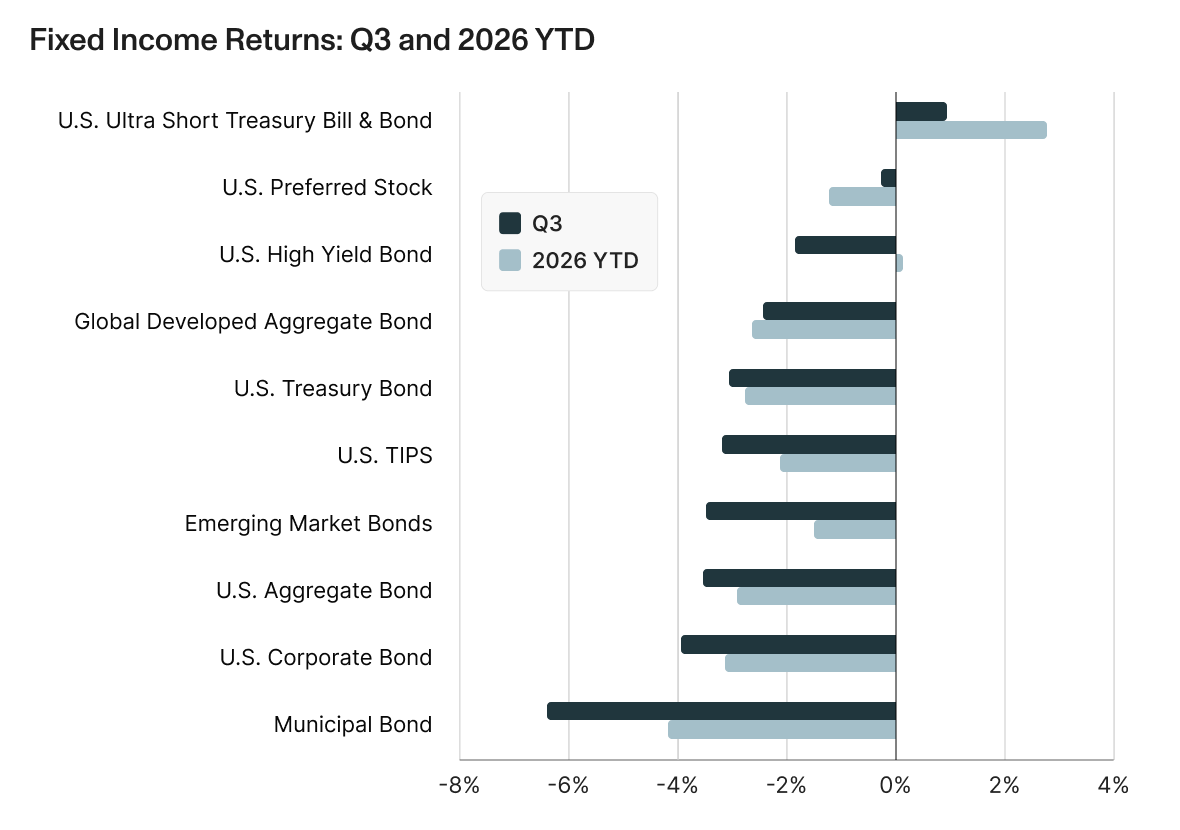
While yields rose to levels that are attractive from an income perspective, the quarter also illustrated the distinction between bond yields and prices. Higher starting yields improve expected income and provide a larger cushion against future rate increases, but bonds can still experience meaningful short-term losses when rates rise quickly. Higher rates also had a variable impact across corporate credit markets, with higher-quality borrowers generally remaining healthy while stress was more apparent among lower-quality borrowers facing higher refinancing costs. For long-term investors, the tradeoff was on display during the quarter: the pain felt in bond prices came as future bond income became more attractive.
Private Markets
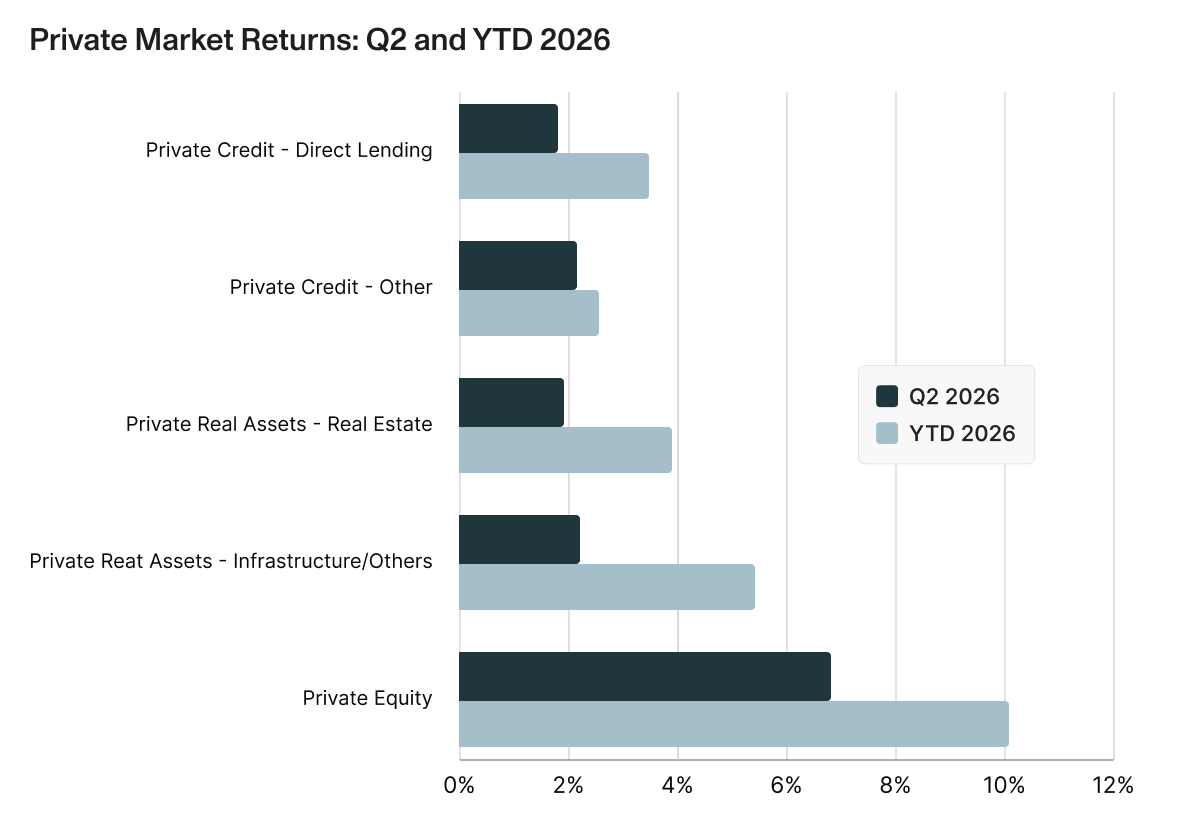
Private equity and venture capital continued to adjust to an environment of higher financing costs and a slower exit market. Secondary-market activity remained elevated as investors and fund managers looked for alternative sources of liquidity, while a large backlog of mature portfolio companies continued to increase pressure for realizations.18 At the same time, substantial private equity dry powder is competing for a limited supply of attractive transactions, increasing the importance of entry valuations and operational improvement rather than relying on cheaper financing to generate returns. In venture capital, AI continued to attract significant investment, but the same question confronting public markets is becoming more relevant in private markets: strong demand for a technology does not guarantee attractive returns on every dollar invested to meet that demand.
Private credit remained an important source of financing as banks and public markets became more selective, but higher borrowing costs continued to increase dispersion among borrowers. Stress has been more evident among smaller and more highly leveraged companies facing refinancing needs.19 Technology and software represent a meaningful share of private credit portfolios, adding another connection between the AI investment cycle and private markets.20 Higher rates are creating dispersion rather than broad distress, increasing the importance of underwriting, capital structure, and the ability of borrowers to generate sufficient cash flow to service more expensive debt.
Private real estate and real assets remained uneven across property types as higher interest rates continued to pressure valuations and transaction activity. Office properties and other segments facing structural changes in demand remain challenged, while data centers and power-related infrastructure continue to benefit from rapidly growing AI investment, creating significant demand for land, electricity, and new construction.21 The asset class is being shaped by differences in property fundamentals and financing needs rather than a single broad real estate cycle.
Beneath the Headlines
Growth: Stronger Than It Feels
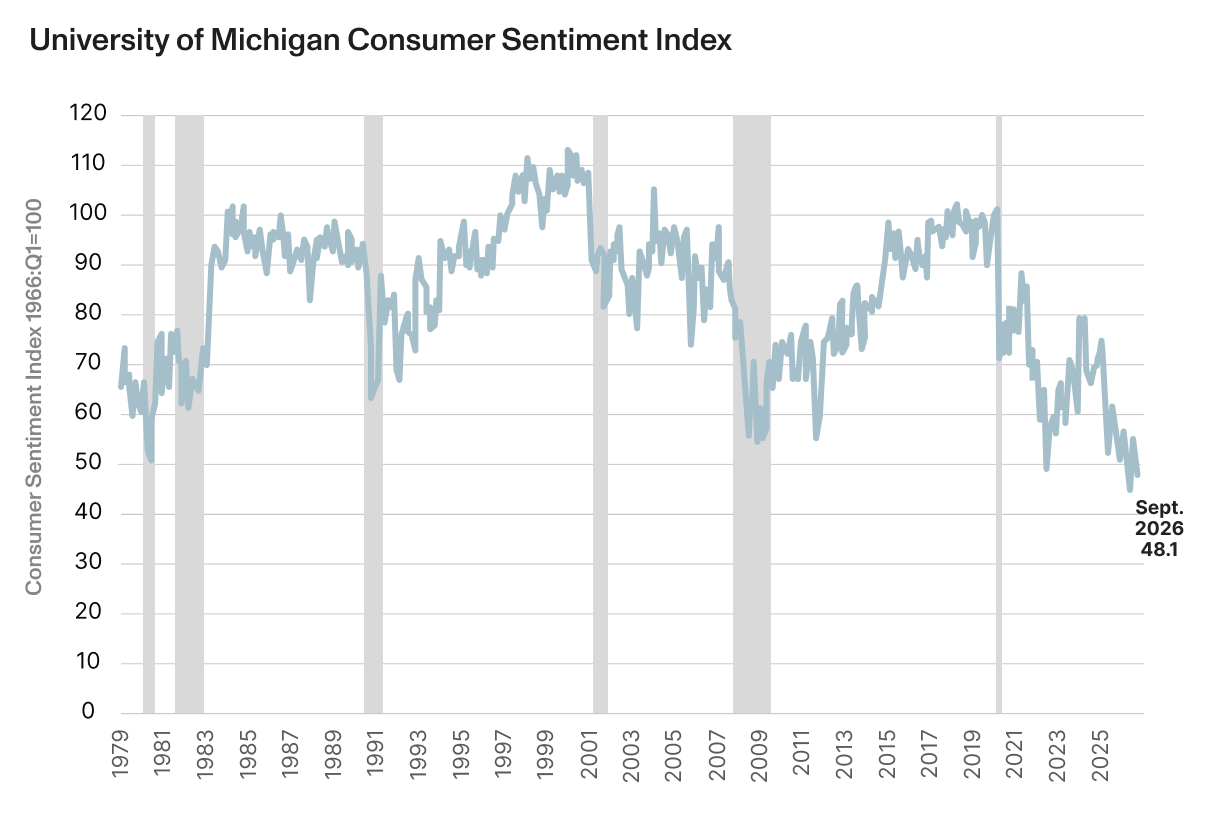
By one important measure, the economy feels unusually weak. The University of Michigan Consumer Sentiment Index fell to 48.1 in September, down 13% from a year earlier and near levels historically associated with periods of significant economic stress.22 Consumers continue to cite high prices and concerns about their personal finances and the economic outlook. Yet weak confidence has not translated into comparably weak economic activity. Consumer spending continued to grow through August, while business activity and investment remained strong. Although sentiment is not always a reliable leading indicator, the gap between sentiment and actual economic activity remained unusually wide at the end of the quarter. Consumers can feel worse before they spend less, making actual spending increasingly important to watch.
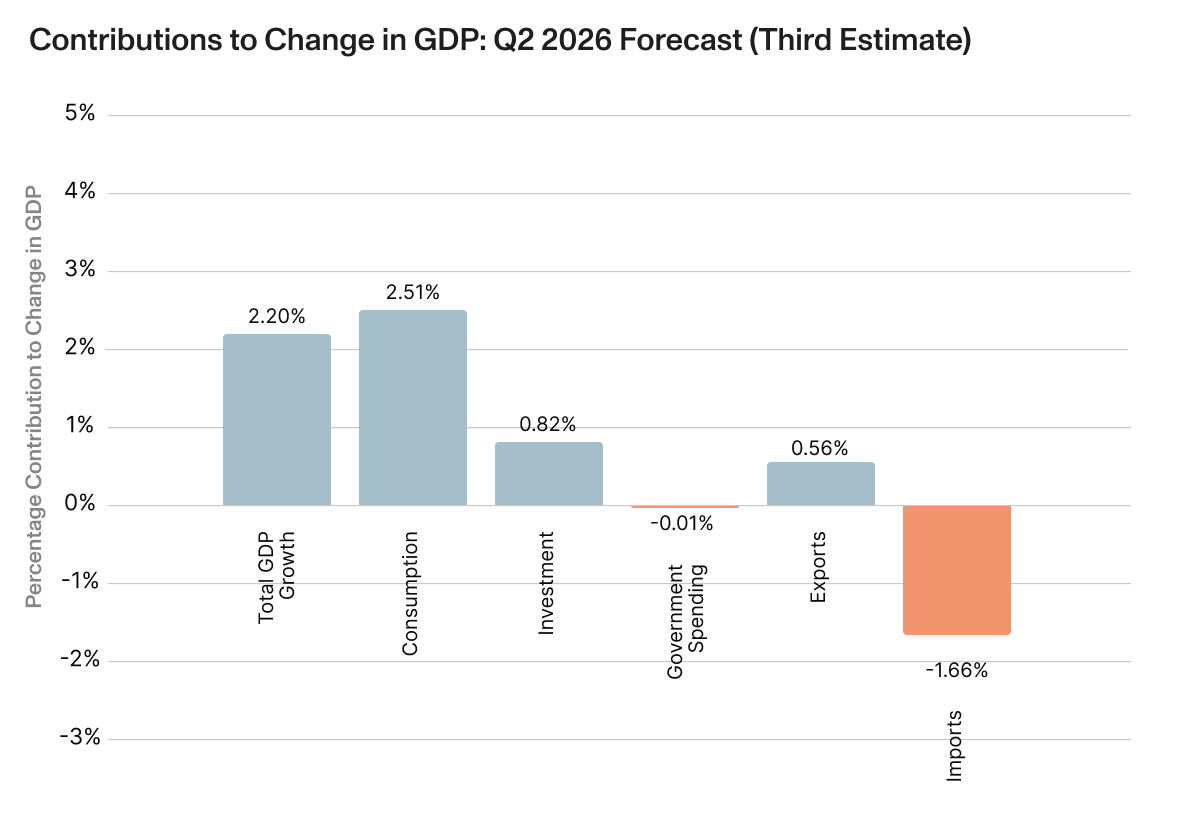
The latest GDP data reinforce that divergence. Second-quarter real GDP growth was revised from 1.5% to 2.2%, with consumer spending contributing 2.5 percentage points and investment another 0.8 percentage point.24 In addition, real final sales to private domestic purchasers—a measure of consumer spending and private fixed investment that strips away some of the more volatile components of GDP—grew at a 4.6% annualized rate.25 That suggests the economy's underlying private demand was even stronger than the headline GDP number alone indicated.
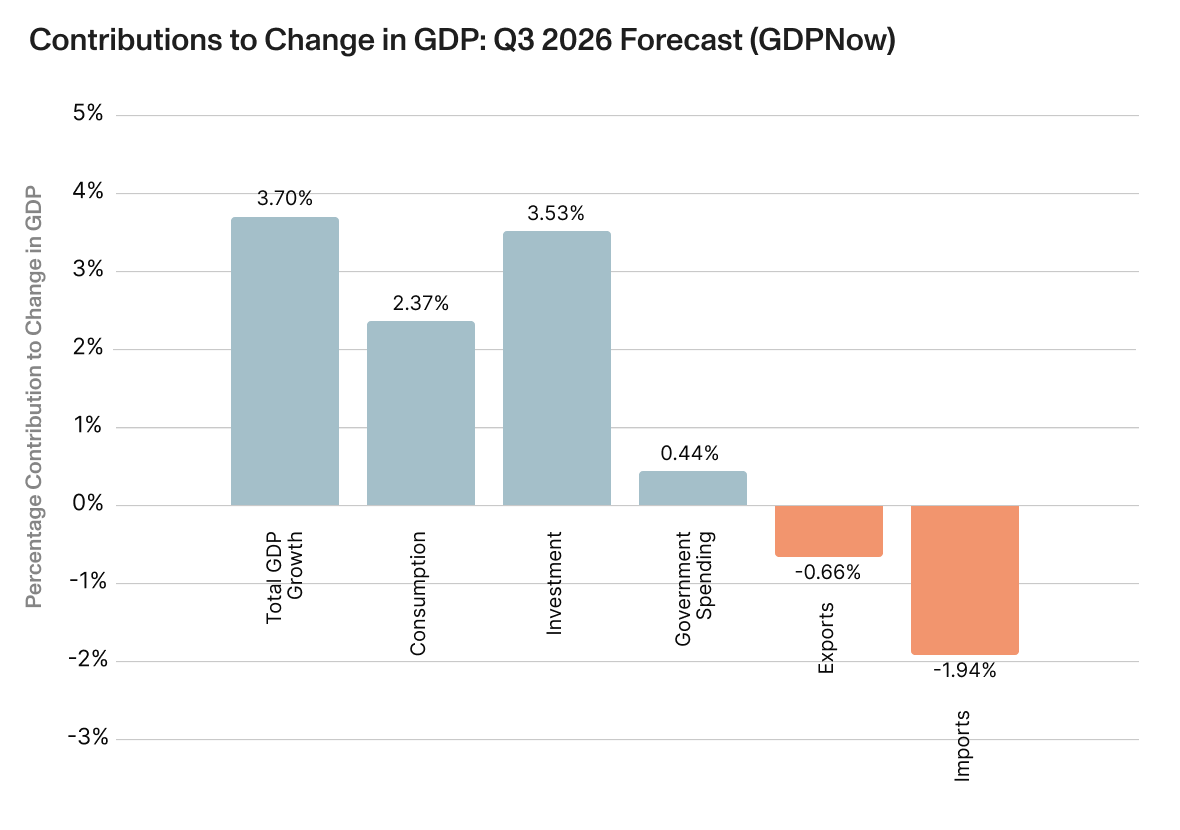
That momentum appears to have continued into the third quarter. As of September 30, the Atlanta Fed's GDPNow model estimated Q3 real GDP growth of 3.7%, with investment contributing an estimated 3.5 percentage points and consumption another 2.4 percentage points.27 The unusually large investment contribution is particularly notable. Spending on technology, data centers and other business investment has become an important source of economic growth, reinforcing the connection between the AI investment boom and the broader economy. GDPNow is a model-based estimate rather than an official forecast, but the composition suggests that growth entering the fourth quarter remained supported by both households and businesses.
The GDP data are consistent with a strongly growing economy, but they are released with a lag. The September employment report therefore adds an important dimension to both the growth and interest-rate outlook. Payrolls increased by just 29,000, prior months were revised lower, and wage growth slowed to 3.0% year over year. At the same time, unemployment remained relatively low at 4.2% and has stayed within a narrow 4.1%–4.3% range since March.29 Slower population and labor-force growth also mean the economy may require fewer new jobs than it did several years ago to keep unemployment relatively stable.30 The economy can therefore be growing faster than the labor market alone might suggest. Strong productivity and investment can support output without requiring the same pace of hiring, but continued weakness in job creation would make the consumer especially important to watch.
Growth and Sentiment — what to watch:
- Consumer spending: Whether weak confidence and high prices begin to translate into slower household spending.
- Business investment: Whether elevated investment—particularly in technology and AI infrastructure—continues to support economic growth.
- Employment: Whether slower hiring reflects a lower-growth labor force and stronger productivity or develops into a broader weakening in labor demand.
What Are Higher Yields Telling Us?
Interest rates moved sharply higher during the third quarter, extending a repricing that has been underway throughout the year. By September 30, the 10-year Treasury yield had risen to 5.29%, compared with 4.46% at the end of June and 4.18% at the beginning of the year. The increase was broad across maturities, with the 2-year Treasury ending the quarter at 4.88% and the 30-year at 5.64%.31 The result is a yield curve that is both higher and more upward sloping than it was at the beginning of the year. Stronger economic growth, persistent inflation, increased government borrowing, and substantial private-sector investment have all contributed to an environment in which borrowers must pay more to attract capital.
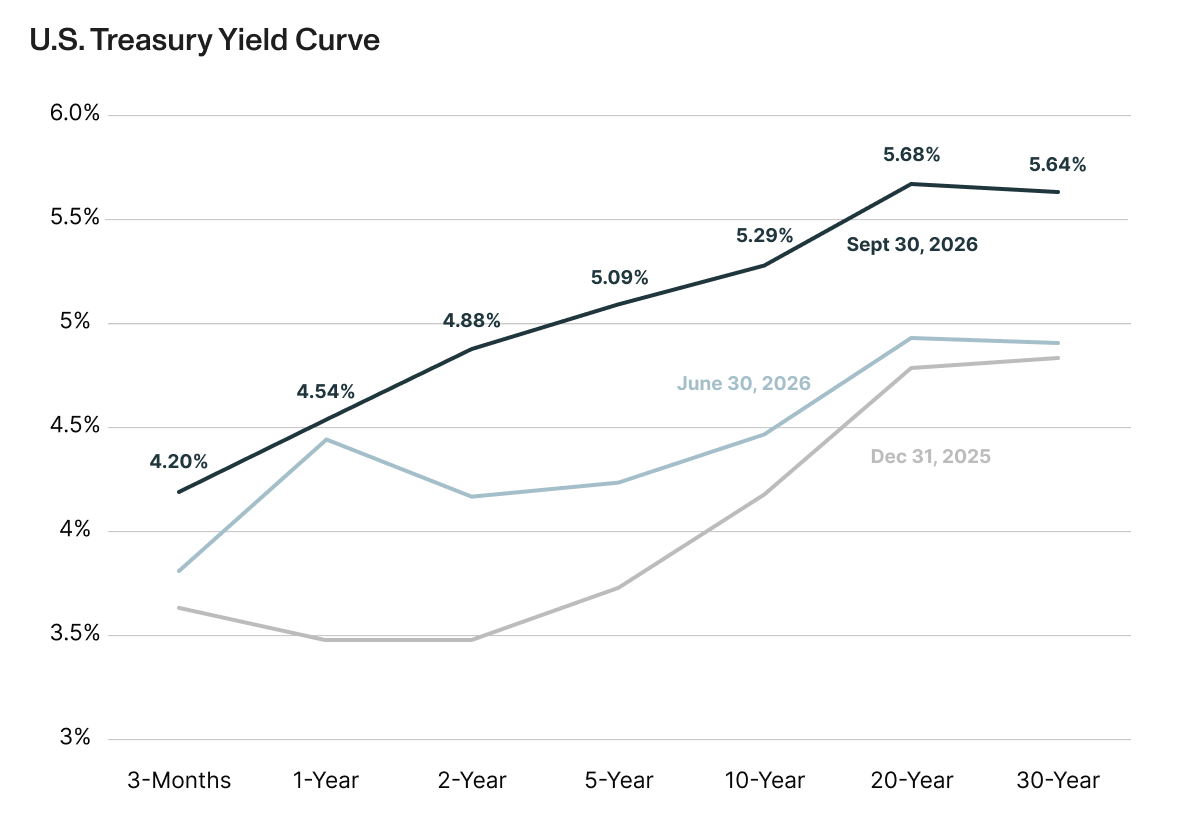
Importantly, the increase in longer-term yields has not primarily been driven by rising inflation expectations. The nominal yield on the 10-year Treasury increased 108 basis points through September, but approximately 98 basis points of that increase came from higher real yields, with only about 10 basis points attributable to higher breakeven inflation (calculated as nominal Treasury yield less TIPS real yield).33 The pattern was similar at the 5- and 30-year maturities. Investors are not simply demanding greater compensation for expected inflation; they are demanding a higher real return for committing capital. That distinction matters because real interest rates represent an important part of the hurdle rate against which investments throughout the economy are evaluated.
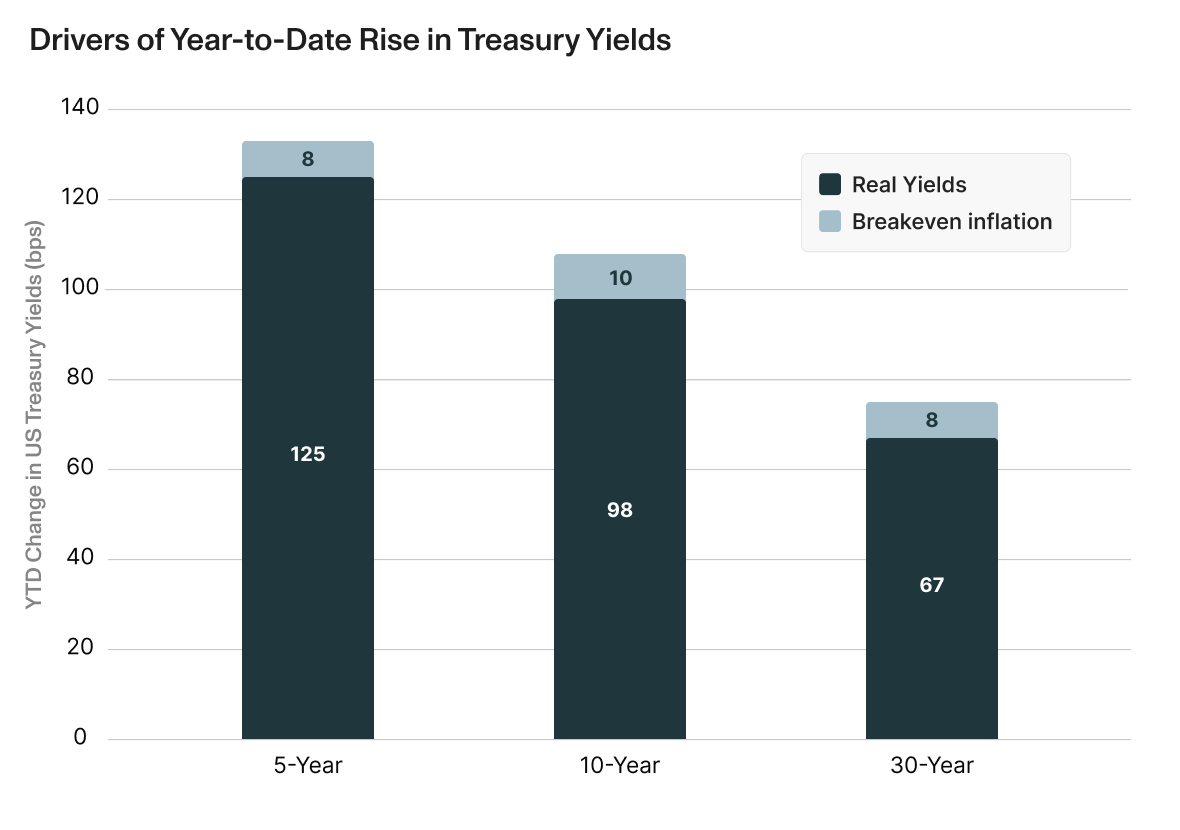
Real yields can rise for several reasons. Strong economic growth and greater demand for capital can support higher real rates, while large government borrowing needs and the extraordinary investment required for AI infrastructure, power generation, and other capital-intensive projects can increase competition among borrowers for the same pool of savings. Higher real yields can therefore be a sign of economic strength, but they can eventually reach levels where they begin to restrain growth. Higher financing costs raise the required return on new investments, increase refinancing costs for existing borrowers, and place greater pressure on valuations across both public and private markets.
The current and expected future level of interest rates creates an important tension heading into the fourth quarter. The economy and corporate earnings have so far been strong enough to absorb substantially higher interest rates, but the hurdle has clearly risen. Softer inflation data at the end of September and weaker September employment data released just after quarter-end reduced expectations for another immediate Fed increase, but they do not reverse the broader rise in longer-term borrowing costs. The question from here is whether economic growth and corporate cash flows can continue to rise quickly enough to clear that higher bar.
Higher Yields — what to watch:
- Real yields: Whether real rates continue rising or begin to stabilize as economic growth and inflation moderate.
- Federal Reserve: Whether softer inflation and employment data allow the Fed to pause after September's rate increase.
- Financing conditions: Whether higher borrowing costs begin to materially restrain business investment, housing, or more highly leveraged borrowers.
AI: From Earnings to Financing
The fundamental case for AI continued to strengthen during the third quarter. S&P 500 earnings growth for Q3 is now expected to reach 29.1%, up from 26.7% at the end of June, while full-year 2026 earnings growth expectations increased from 24.0% to 32.0%.35 Much of that improvement has been driven by technology and AI-related companies, where strong cloud demand, rising AI usage, and expanding backlogs have increasingly translated investment into revenue and earnings. The evidence that AI demand is real has strengthened. The more difficult question is whether the eventual cash flows will justify the extraordinary amount of capital being invested to meet that demand.
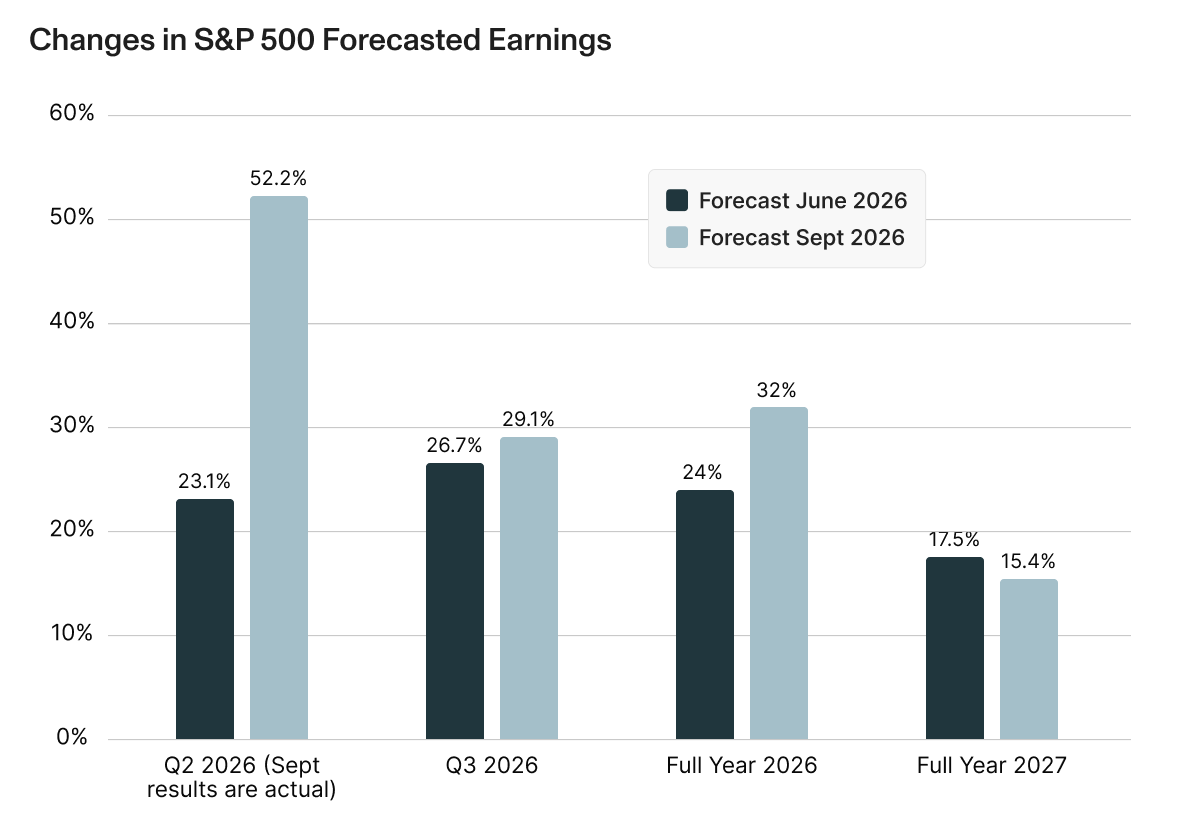
That question is becoming more important as the AI buildout expands beyond companies' internally generated cash flows. The largest technology companies remain highly profitable and generally have exceptionally strong balance sheets, but their capital requirements are growing rapidly. Spending on data centers, semiconductors, power generation, and related infrastructure is increasingly being financed through public debt, private credit, asset-backed securities, and other capital markets. As a result, AI exposure is no longer confined to equities as the financing of AI now runs through credit markets as well.
AllianceBernstein estimates that hyperscalers accounted for 2.7% of the U.S. investment-grade corporate bond index in 2025, rising to 4.8% in 2026 and potentially 8.8% by 2030.37 That does not necessarily indicate financial stress. The largest AI companies generally have substantially stronger balance sheets and greater interest coverage than the typical public company, and credit markets have so far absorbed increased issuance without major disruption. But it does mean that investors who own both stocks and bonds may have exposure to the same underlying economic driver through different parts of their portfolios.
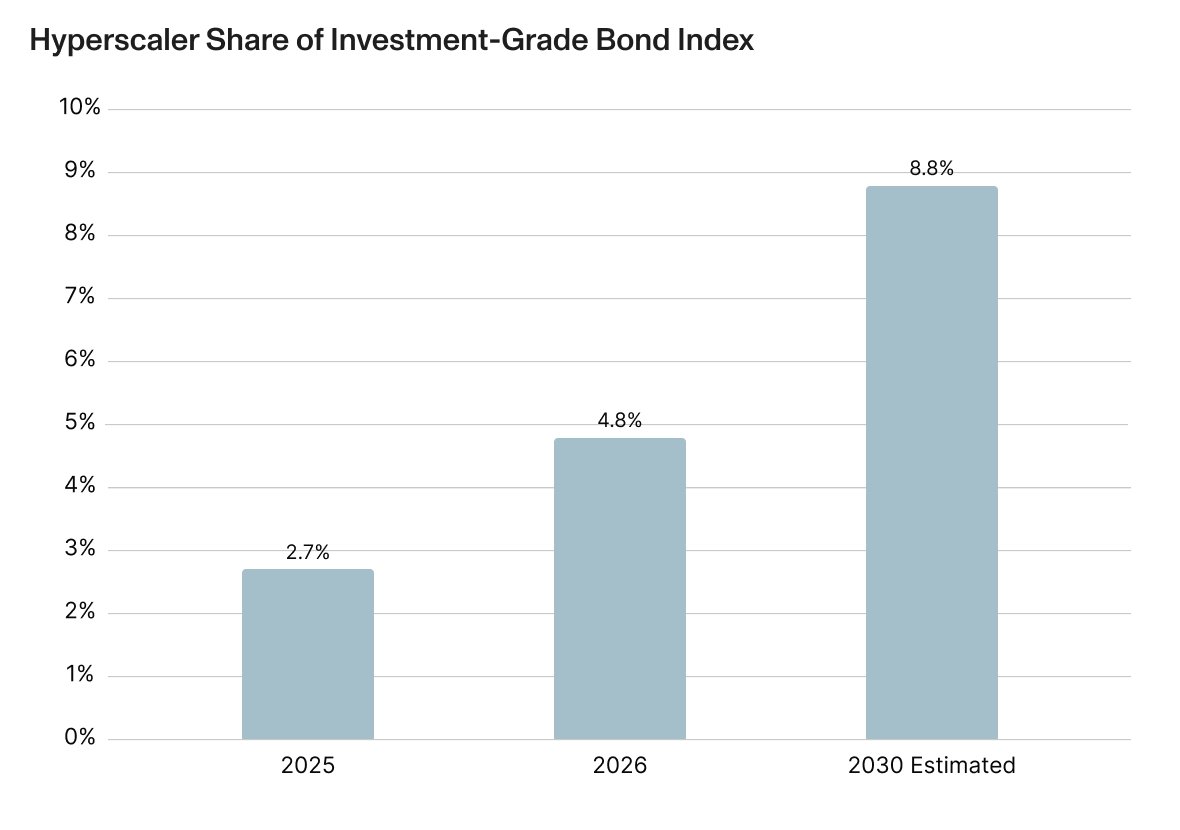
The evolution of financing sources also raises the hurdle for the investments themselves. Data centers and other AI infrastructure require enormous upfront capital commitments, while some of the technology underpinning that infrastructure faces relatively rapid obsolescence risk.39 Greater use of outside capital also means that future revenues must support not only operating expenses but also an expanding financing burden. AI demand does not need to disappoint for investment returns to vary widely. AI can create enormous economic value without every dollar invested in the buildout earning an attractive return. As the investment cycle matures, the distinction between technological success and investment success is likely to become even more important.
AI Earnings and Financing — what to watch:
- Monetization: Whether cloud growth, AI adoption, and productivity gains continue translating investment into revenue and earnings.
- Financing: How quickly AI infrastructure moves from internally generated cash flow toward public and private debt markets.
- Returns on investment: Whether incremental cash flows grow quickly enough to justify rising capital expenditures and financing costs.
Looking Ahead
As the fourth quarter begins, investors face an unusual combination of strong economic growth, rapidly rising corporate earnings, and significantly higher interest rates. The economy has so far absorbed higher borrowing costs better than many expected, while corporate profits have continued to support equity markets. At the same time, softer inflation and employment data late in the quarter suggest that some of the pressures pushing rates higher may be moderating. The key question is whether growth can remain healthy enough to support earnings while cooling enough to ease pressure on inflation and interest rates.
Higher real interest rates nevertheless leave a higher hurdle across public and private markets, placing greater emphasis on earnings, cash flows, balance sheets, and valuations. AI development is the key example: demand and earnings continue to strengthen, but so does the amount of capital required to finance the buildout. Policy uncertainty around the approaching midterm elections may add another variable, but growth, earnings, inflation, and interest rates remain the more immediate market drivers. The third quarter demonstrated that a strong economy is not necessarily an easy environment for investors. As the bar rises, the distinction between growth and profitable growth—and between investment and productive investment—becomes increasingly important.
Compound provides everything you need to manage your finances (liquidity planning, concentrated position management, stock option optimization, and more).
[1] https://www.sca.isr.umich.edu/
[2] https://www.bea.gov/data/gdp/gross-domestic-product
[3] https://www.bls.gov/news.release/empsit.nr0.htm
[4] https://insight.factset.com/topic/earnings
[5] https://www.spglobal.com/spdji/en/index-family/equity/
[6] https://www.spglobal.com/spdji/en/index-family/fixed-income/
[7] https://www.bea.gov/data/personal-consumption-expenditures-price-index
[8] https://www.bls.gov/news.release/empsit.nr0.htm
[9] https://www.federalreserve.gov/newsevents/pressreleases/monetary20260916a.htm
[10] https://www.spglobal.com/spdji/en/index-family/equity/
[11] https://www.spglobal.com/spdji/en/index-family/equity/
[12] https://www.msci.com/end-of-day-data-search
[13] https://www.nasdaq.com/market-activity/index/comp/historical
[14] spglobal.com/spdji/en/index-family/equity/us-equity/sp-sectors/
[15] https://insight.factset.com/topic/earnings
[16] https://www.spglobal.com/spdji/en/index-family/fixed-income/
[17] https://www.spglobal.com/spdji/en/index-family/fixed-income/
[18] https://am.jpmorgan.com/us/en/asset-management/adv/insights/market-insights/guide-to-alternatives/
[19] https://www.apollo.com/wealth/insights-news/insights/2026/08/2026-midyear-credit-outlook
[20] https://am.jpmorgan.com/us/en/asset-management/adv/insights/market-insights/guide-to-alternatives/
[21] https://am.jpmorgan.com/us/en/asset-management/adv/insights/market-insights/guide-to-alternatives/
[22] https://www.sca.isr.umich.edu/
[23] https://www.sca.isr.umich.edu/
[24] https://www.bea.gov/data/gdp/gross-domestic-product
[25] https://www.bea.gov/data/gdp/gross-domestic-product
[26] https://www.bea.gov/data/gdp/gross-domestic-product
[27] https://www.atlantafed.org/research-and-data/data/gdpnow
[28] https://www.atlantafed.org/research-and-data/data/gdpnow
[29] https://www.bls.gov/news.release/empsit.nr0.htm
[30] https://www.apollo.com/wealth/insights-news/insights/daily-spark/Why-Weak-Payrolls-Are-No-Longer-Weak
[31] https://home.treasury.gov/policy-issues/financing-the-government/interest-rate-statistics
[32] https://home.treasury.gov/policy-issues/financing-the-government/interest-rate-statistics
[33] https://www.federalreserve.gov/releases/h15/ and author calculations.
[34]https://www.federalreserve.gov/releases/h15/
[35] https://insight.factset.com/topic/earnings
[36] https://insight.factset.com/topic/earnings
[37] https://www.alliancebernstein.com/americas/en/institutions/insights/investment-insights/the-everything-trade.html
[38] https://www.alliancebernstein.com/americas/en/institutions/insights/investment-insights/the-everything-trade.html
[39] https://www.ssga.com/us/en/intermediary/insights/impact-of-rising-financing-costs-on-the-ai-capex-cycle