
Growth Meets Its Constraints

Compound is a digital family office for entrepreneurs, professionals, and retirees who want the personal touch of a dedicated advisor accompanied by a beautiful digital experience.
October highlighted a growing distinction between the strength of the U.S. economy and the performance of financial markets. Economic growth accelerated, corporate earnings expectations continued to improve, and investment in artificial intelligence remained a powerful source of economic activity. Yet financial markets delivered sharply divergent results, with investors rotating away from the technology companies that have dominated recent years toward a broader range of sectors and investment styles. October's rotation illustrates how valuations and investor expectations can produce sharply different returns even when underlying fundamentals remain strong.
As we approach the final months of 2026, the outlook remains constructive but faces meaningful constraints. Persistent inflation has limited the Federal Reserve's flexibility, elevated borrowing costs continue to challenge parts of the economy, and the enormous capital commitments supporting the AI investment cycle are facing greater scrutiny. Meanwhile, the midterm elections have introduced a period of divided government, potentially limiting major legislative changes while leaving uncertainty around fiscal and regulatory policy. Together, these developments underscore how economic growth can remain resilient even as the conditions supporting financial market returns become more demanding.
October at a glance
- Economic Growth and Earnings: Third-quarter economic growth accelerated, supported by resilient consumer spending and business investment, while corporate earnings remained strong and forecasts continued to rise.1 2 However, increasingly divergent earnings results and market performance highlighted the difference between healthy economic fundamentals and investment returns.
- Inflation and Monetary Policy: Persistent inflation complicated the Federal Reserve's policy outlook despite continued economic strength. The Fed held interest rates steady in October, but renewed concerns about inflation and the possibility of further tightening underscored the constraints facing the economy and financial markets.3 4
- Equity Markets: U.S. equities experienced a sharp rotation away from mega-cap technology and growth stocks toward value, defensive sectors, and smaller companies. Despite modest weakness in the S&P 500, broader market participation improved significantly.5
- Fixed Income: Fixed income markets rebounded as Treasury yields declined, providing diversification during the equity market's technology-led selloff. Investment-grade bonds and municipal securities posted solid gains, while riskier credit segments generally lagged.6
- Artificial Intelligence: Anthropic's IPO filing and disappointing reactions to several major technology companies' earnings intensified scrutiny of the AI investment cycle. While AI-related spending continues to support economic growth, investors are increasingly focused on whether those investments will generate sufficient profits and cash flow to justify their cost.7
- Midterm Elections: Democrats won control of both the House and Senate in November's midterm elections, creating a divided government. While markets have historically viewed legislative gridlock favorably because it can limit major policy changes, economic fundamentals, corporate earnings, and monetary policy remain more important drivers of long-term investment returns.
Stocks: Broadening Beneath the Surface
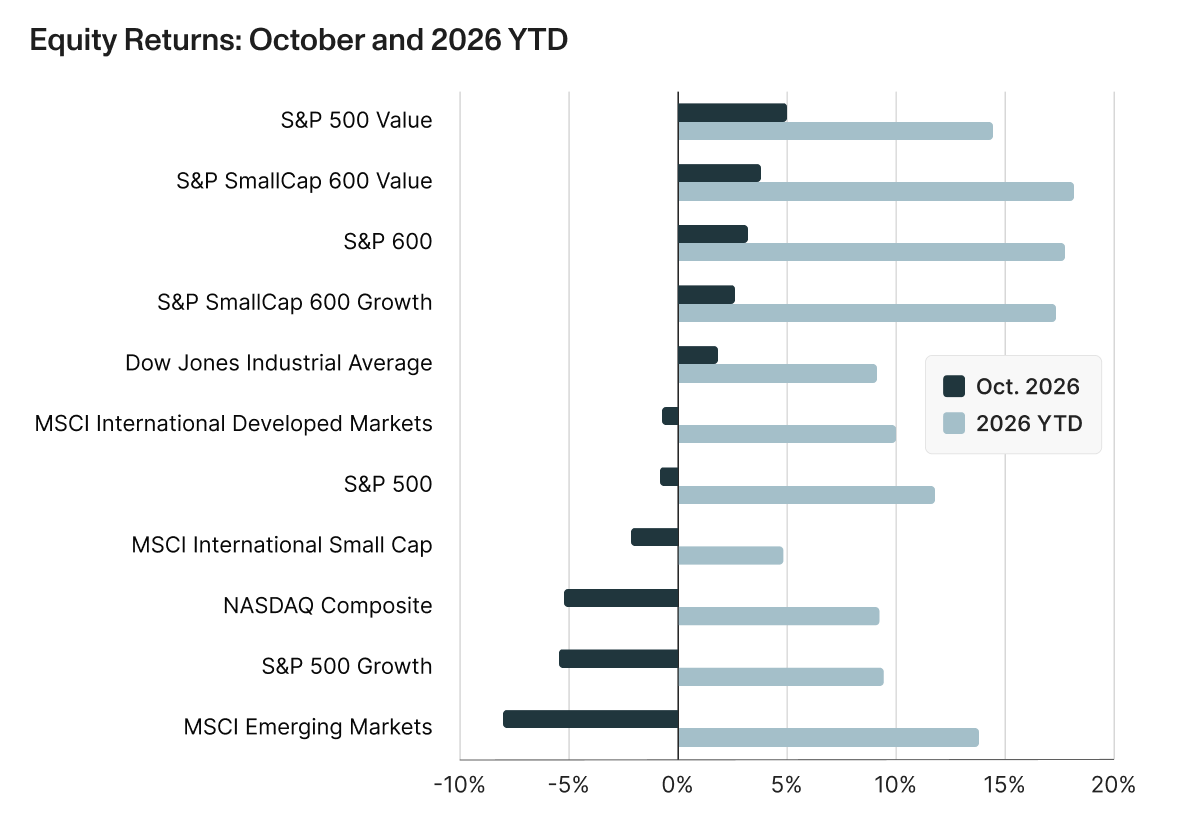
U.S. equity markets delivered sharply divergent returns in October as investors rotated away from the technology and growth stocks that have dominated market performance in recent years. The S&P 500 declined 0.9% for the month, while the technology-heavy NASDAQ Composite fell 5.3%.8 9 Those headline declines concealed substantial gains across value stocks, smaller companies, and several defensive sectors, suggesting that investors were becoming more selective rather than broadly retreating from equities.
The divergence was particularly evident across investment styles and company sizes. The S&P 500 Value Index gained 4.9% in October, compared with a 5.4% decline for the S&P 500 Growth Index. Small-cap stocks also performed well, with the S&P 600 advancing 3.2% and both its value and growth components posting positive returns. International developed markets declined modestly, while emerging markets fell 8.0%, driven in part by sharp declines in major South Korean semiconductor companies, including Samsung Electronics and SK Hynix, amid growing concerns about the AI investment cycle. Despite October's weakness, all major equity indices remained positive for the year.10
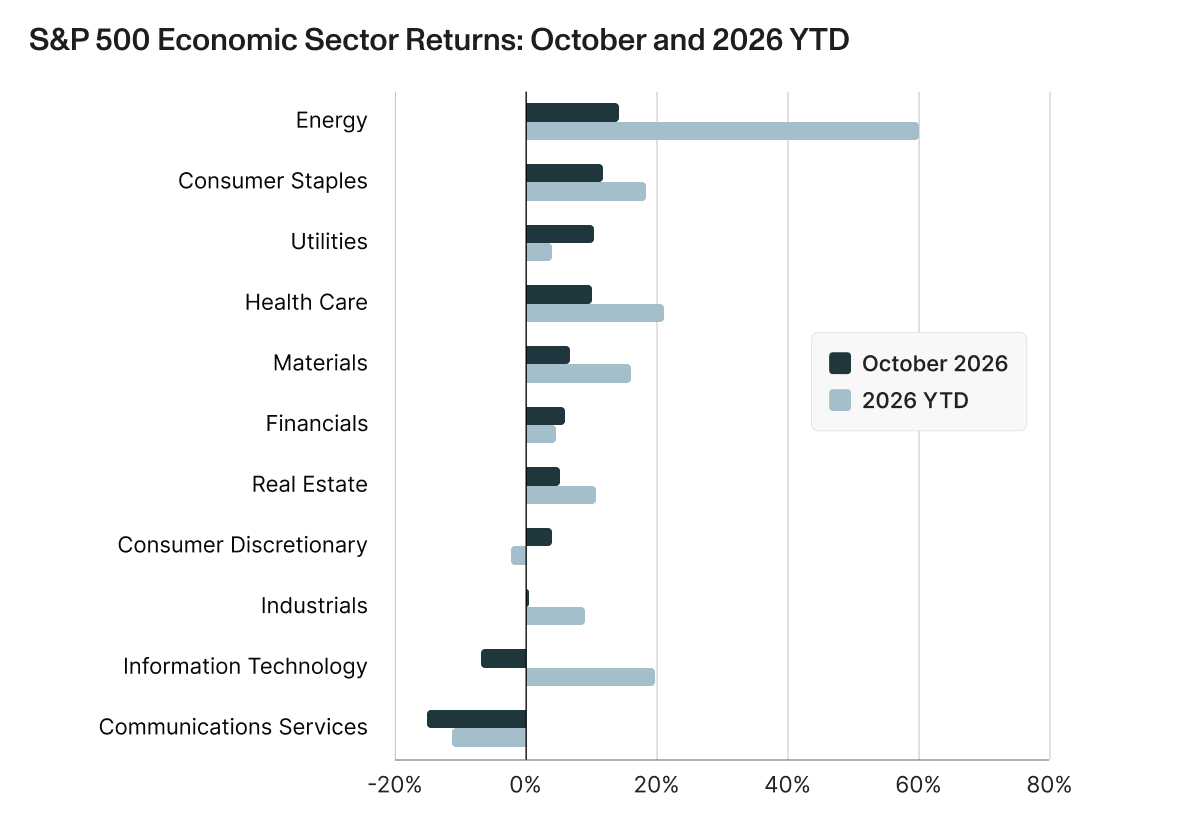
Sector performance reinforced this rotation.14 Energy led the S&P 500 with a 14.0% gain in October, extending its year-to-date return to nearly 60%, substantially ahead of every other sector. Consumer Staples, Utilities, and Health Care also recorded strong monthly gains, each advancing approximately 10% or more. Financials, Materials, and Real Estate posted solid gains as well. In contrast, Information Technology declined 6.8%, while Communication Services fell 15.1%. The magnitude of these differences illustrates how weakness among a relatively small number of large companies can obscure broader market strength.
The shift occurred against a backdrop of resilient economic growth and generally supportive corporate earnings. However, investors became increasingly sensitive to the gap between expectations and results, particularly among companies making substantial investments in artificial intelligence. Strong revenue growth and ambitious spending plans were no longer sufficient to support valuations when questions emerged about profitability, cash flow, and the timing of future returns.
October's sharp rotation illustrates how quickly market leadership can change. After years of concentrated gains among the largest technology companies, stronger performance across other sectors and investment styles has created a broader set of opportunities. Whether that shift persists will depend on earnings growth and valuations, reinforcing the importance of diversification.
Fixed Income
Fixed income markets rebounded in October as declining Treasury yields supported bond prices, providing a welcome source of diversification during a volatile month for equities. The 10-year Treasury yield fell from 5.29% at the end of September to 4.94% at the end of October, while the 2-year yield declined from 4.88% to 4.56%.16 The rally occurred despite persistent inflation concerns and the Federal Reserve's decision to leave its benchmark interest rate unchanged. Although yields declined, borrowing costs remained elevated, reflecting the continued tension between resilient economic growth and inflation that remains above the Fed's target.
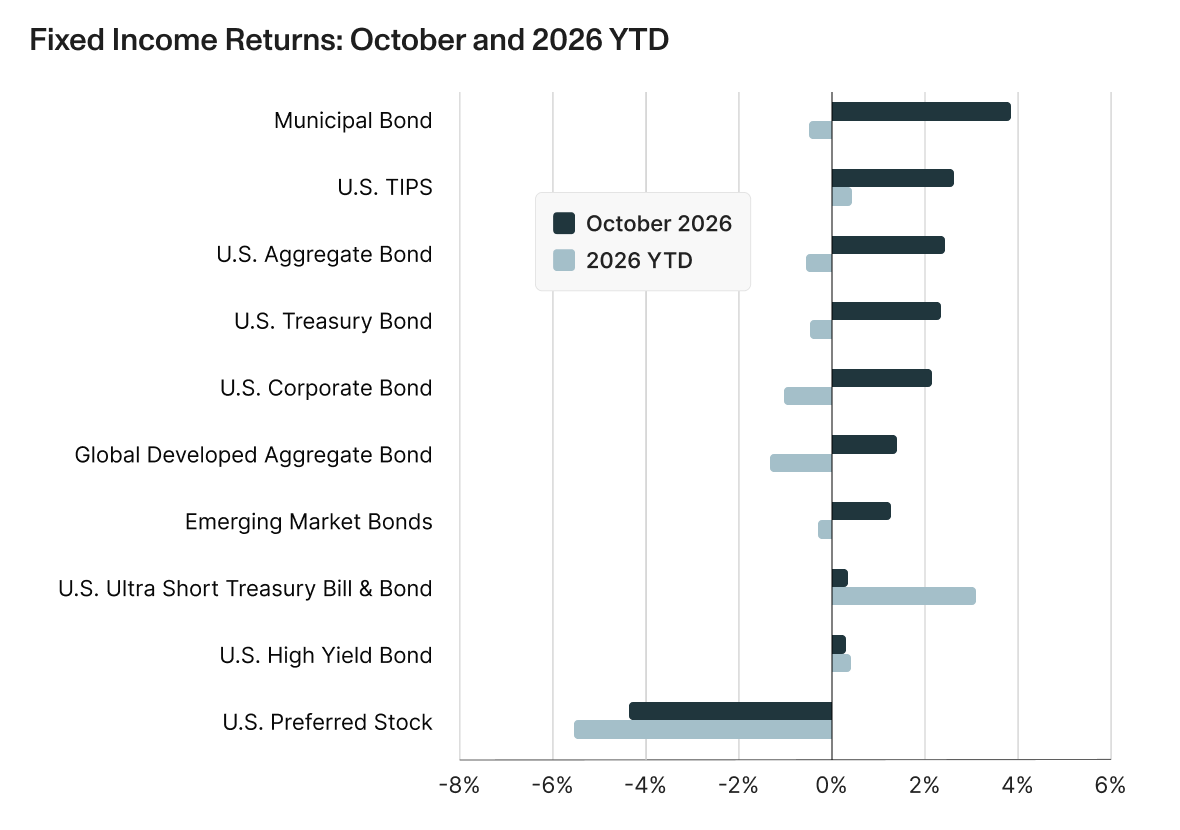
Most major fixed income categories posted positive returns for the month.17 Municipal bonds led the gains, advancing nearly 4% after an especially weak September. Treasury Inflation-Protected Securities (TIPS), the U.S. Aggregate Bond Index, and U.S. Treasuries each were up just over 2%. Investment-grade corporate bonds also performed well, while high-yield and emerging market bonds posted more modest gains. Preferred securities were a notable exception, declining more than 4%. Despite October's rebound, most major bond indices remained slightly negative for the year, with ultra-short Treasury securities among the few categories delivering positive year-to-date returns.
October demonstrated the diversification benefits that high-quality bonds can provide in bouts of equity market volatility, particularly when declining interest rates support bond prices. However, the broader fixed income environment remains challenging. Elevated yields offer investors more attractive income opportunities than in much of the past decade, but persistent inflation, fiscal pressures, and uncertainty surrounding Federal Reserve policy continue to create risks. With yields still elevated, investors can earn meaningful income from high-quality bonds, although the trade-off between interest-rate risk and credit risk remains important.
Private Markets
Private equity and venture capital activity continued to show signs of improvement in October, although the recovery remained uneven. Exit values increased during the third quarter, but transaction volumes remained subdued as elevated financing costs and valuation differences between buyers and sellers continued to constrain activity.19 Distributions to investors remained a challenge, contributing to longer holding periods and a more selective fundraising environment. Venture capital activity remained concentrated in artificial intelligence and other high-growth technology businesses, with Anthropic's planned IPO highlighting both the scale of investor interest and the increasingly demanding valuations in the sector.
Private credit continued to face pressure from elevated borrowing costs and deteriorating credit quality among more highly leveraged borrowers. Fitch reported that its trailing 12-month private credit default rate reached 6.3% in the third quarter for their monitored private credit universe, the highest level in its historical series, with distressed maturity extensions and deferred interest payments accounting for much of the increase.20 Redemption requests at non-traded business development companies moderated from the prior quarter but remained elevated, highlighting continued liquidity pressures.21 These developments place greater emphasis on underwriting standards, manager selection, and fund liquidity provisions.
Private real estate and real assets: Private real estate continued to experience an uneven recovery, with improving conditions in selected property sectors offset by elevated financing costs and refinancing challenges.22 Investor interest remained concentrated in higher-quality residential and industrial properties, while broader fundraising activity remained subdued. Real assets tied to energy and infrastructure continued to attract capital, particularly as expanding AI data center investment increased demand for electricity generation, transmission, and related infrastructure.
Beneath the Headlines
Testing the Economics of AI
Artificial intelligence continues to be an important driver of economic growth, corporate investment, and financial markets. Spending on data centers, semiconductors, and related infrastructure has accelerated, supporting business investment and economic activity even as other parts of the economy face pressure from elevated interest rates. However, as the scale of spending increases, investors are becoming more focused on a fundamental question: Will the economic benefits of AI ultimately generate sufficient profits to justify the enormous capital being committed?
Recent earnings reports from major technology companies have highlighted this tension, with rapid growth in cloud computing and AI services demonstrating strong demand for the technology. At the same time, the largest technology companies are committing unprecedented amounts of capital to expand computing capacity, raising concerns about future cash flow, profitability, and returns on investment. October's sharp declines in several technology stocks suggest that investors are becoming less willing to reward spending announcements alone, even when underlying business growth remains strong.
Anthropic's October 26 IPO filing provides a particularly revealing look at the economics of the AI industry. The developer of the Claude AI models reported approximately $16.3 billion in revenue during the first half of 2026, including $11.6 billion in the second quarter alone, demonstrating extraordinary growth in demand for its services.23 Operating profitability has also improved significantly as computing costs have declined relative to revenue. Nevertheless, the company's business remains exceptionally capital-intensive, with substantial long-term commitments for computing infrastructure and continued investment required to develop increasingly sophisticated AI models. These obligations create significant financial risks if future revenue growth or pricing fails to meet expectations.
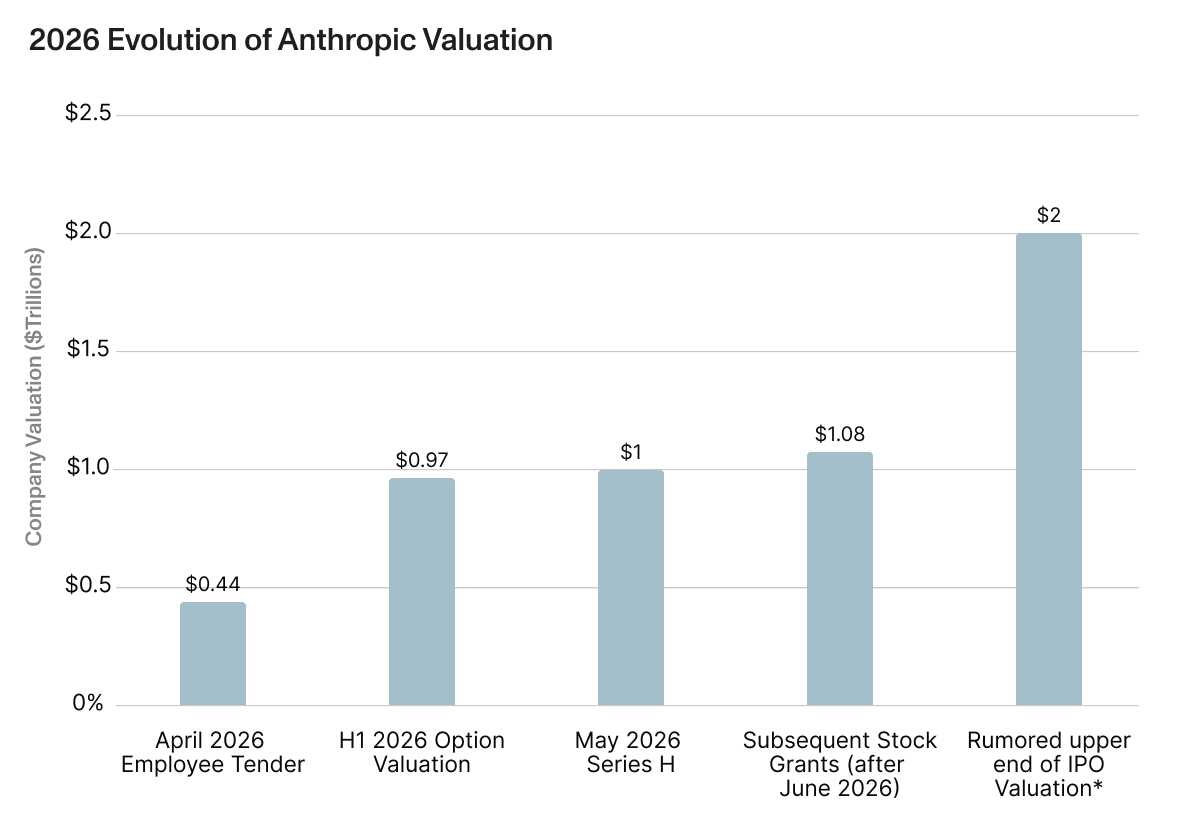
The company's rapidly increasing valuation illustrates the expectations accompanying this growth. Anthropic was valued at approximately $440 billion in an April employee tender offer, followed by equity valuations approaching or exceeding $1 trillion during subsequent financing and compensation transactions.24 Media reports have suggested that its IPO could value the company at as much as $2 trillion, although the final offering price has not been established.25 26 These figures reflect remarkable investor enthusiasm, but they also raise the hurdle for future returns. Even a company experiencing extraordinary revenue growth can prove to be a disappointing investment if its valuation already assumes exceptional long-term success.
Anthropic's IPO highlights both the opportunities and uncertainties of the broader AI investment cycle. The technology is generating real demand, accelerating business investment, and creating substantial economic value. However, the distribution of that value among model developers, cloud providers, semiconductor manufacturers, and end users remains uncertain. As competition intensifies and computing capacity expands, lower prices and improving efficiency may benefit customers without necessarily producing equally attractive returns for every company financing the buildout. For investors, the next phase of the AI cycle will increasingly depend on evidence of sustainable profitability, disciplined capital allocation, and valuations supported by achievable earnings expectations.
AI Economics — what to watch:
- Whether AI-related revenue and cash flow grow sufficiently to support continued infrastructure spending.
- Will Anthropic's ultimate IPO valuation reflect sustainable long-term earnings potential?
- Is improving AI efficiency translating into stronger profitability or greater pricing competition?
Growth: Strong Fundamentals and Uneven Rewards
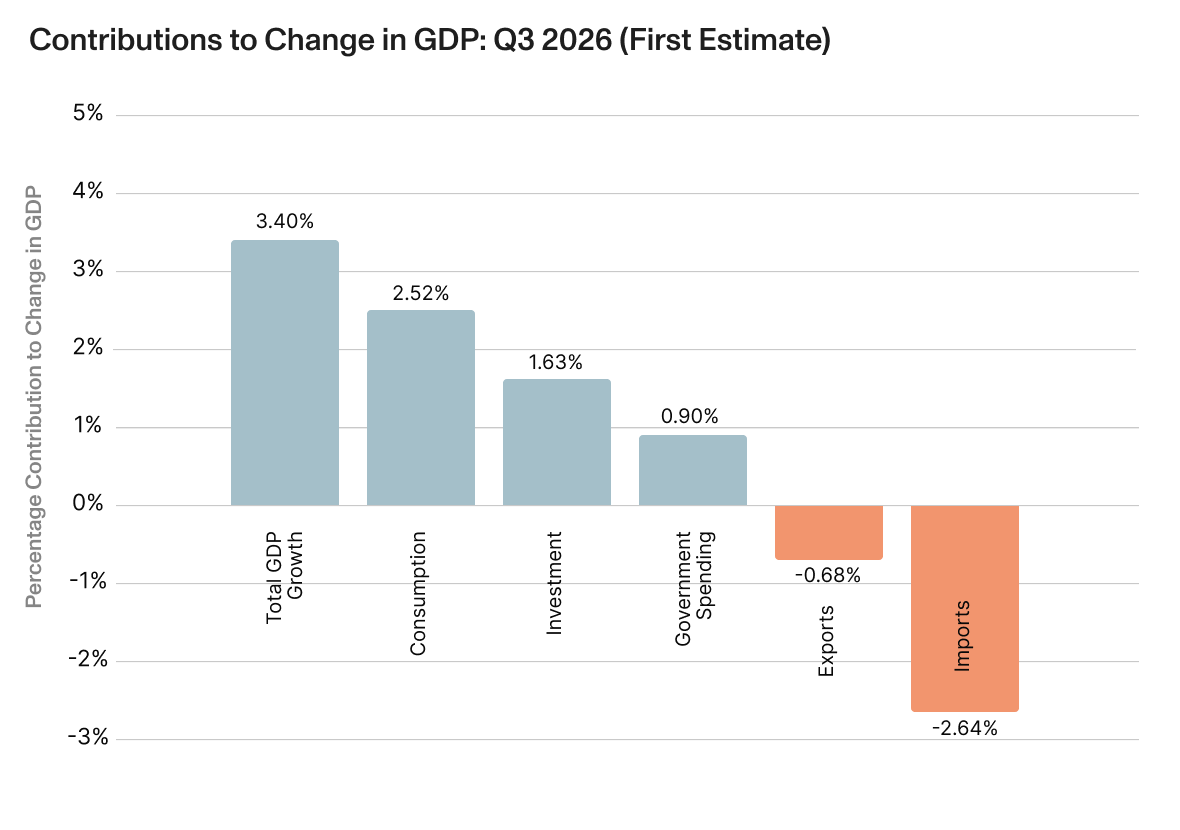
The U.S. economy continued to expand at a solid pace in the third quarter, with real GDP expanding at a 3.4% annualized rate, accelerating from 2.2% in the second quarter.30 Consumer spending remained the largest contributor to growth, adding 2.5 percentage points, while investment contributed another 1.6 percentage points. Business investment was particularly strong, supported by continued spending on technology, equipment, and infrastructure. However, the strength of domestic demand was partly offset by a widening trade deficit, as imports grew faster than exports.
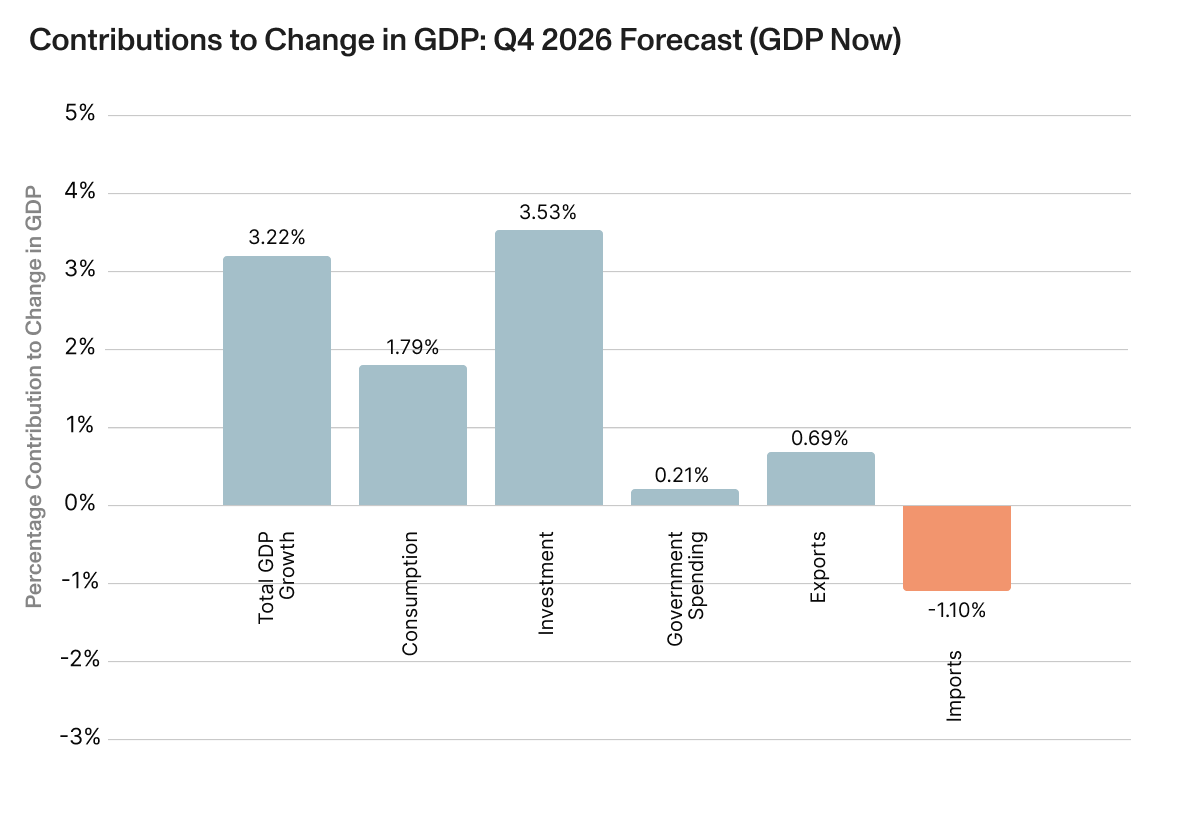
Early estimates suggest that economic momentum may continue into the fourth quarter. The Atlanta Fed's GDPNow model projected growth of 3.2% as of the end of October, with investment expected to become an even larger contributor than consumer spending. While these estimates are subject to significant revisions as additional data become available, they suggest that the economy entered the final months of the year with considerable momentum. The changing composition of growth is also noteworthy: continued strength in capital investment provides an important source of economic activity, but raises questions about how sustainable that spending will be and whether it will ultimately generate adequate returns.
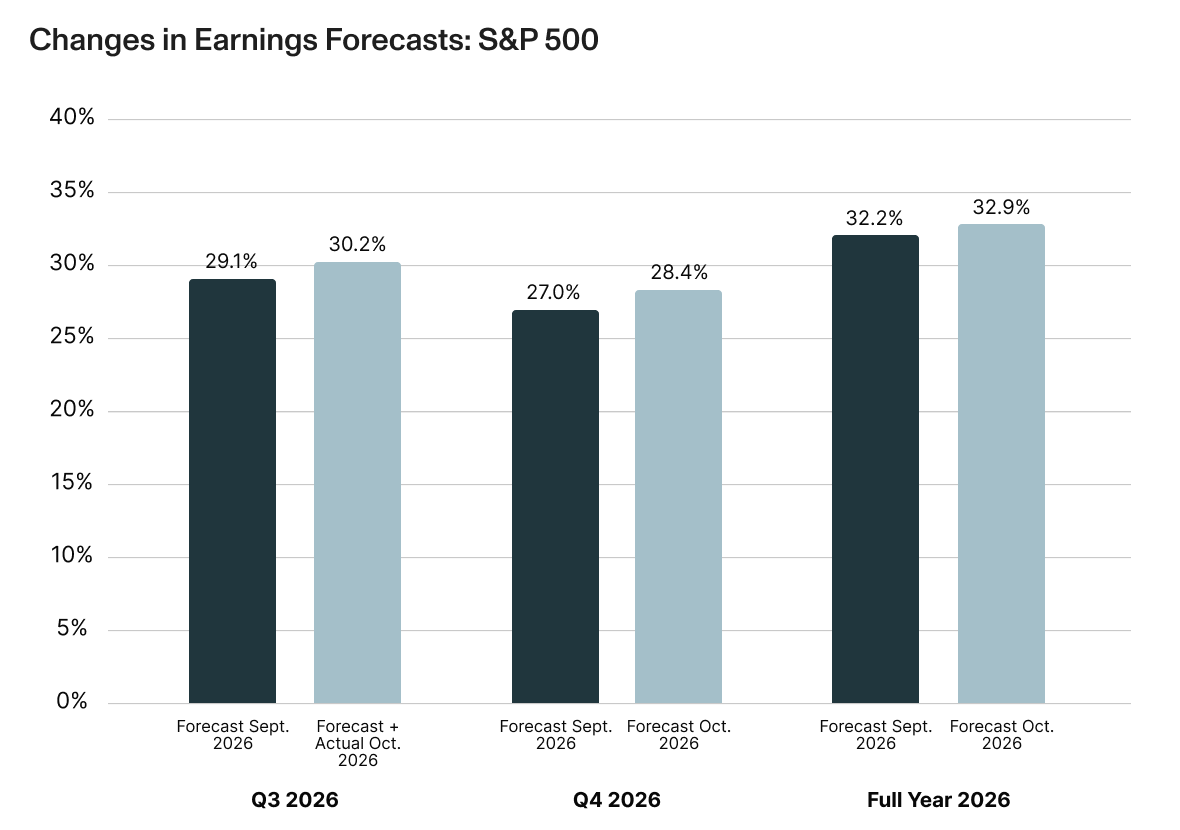
Strong economic activity has been accompanied by continued improvement in corporate earnings expectations. With approximately 60% of S&P 500 companies having reported third-quarter results, blended actual plus forecasted earnings growth reached 30.2% year-over-year, up from the 29.1% expected at the end of September.33 More importantly, analysts also increased their forecasts for the fourth quarter and full year, with expected earnings growth reaching 28.4% and 32.9%, respectively. These upward revisions are notable because analysts have continued raising estimates even as the reporting season has progressed. Rather than relying solely on higher valuations, equity markets have benefited from improving underlying profitability.
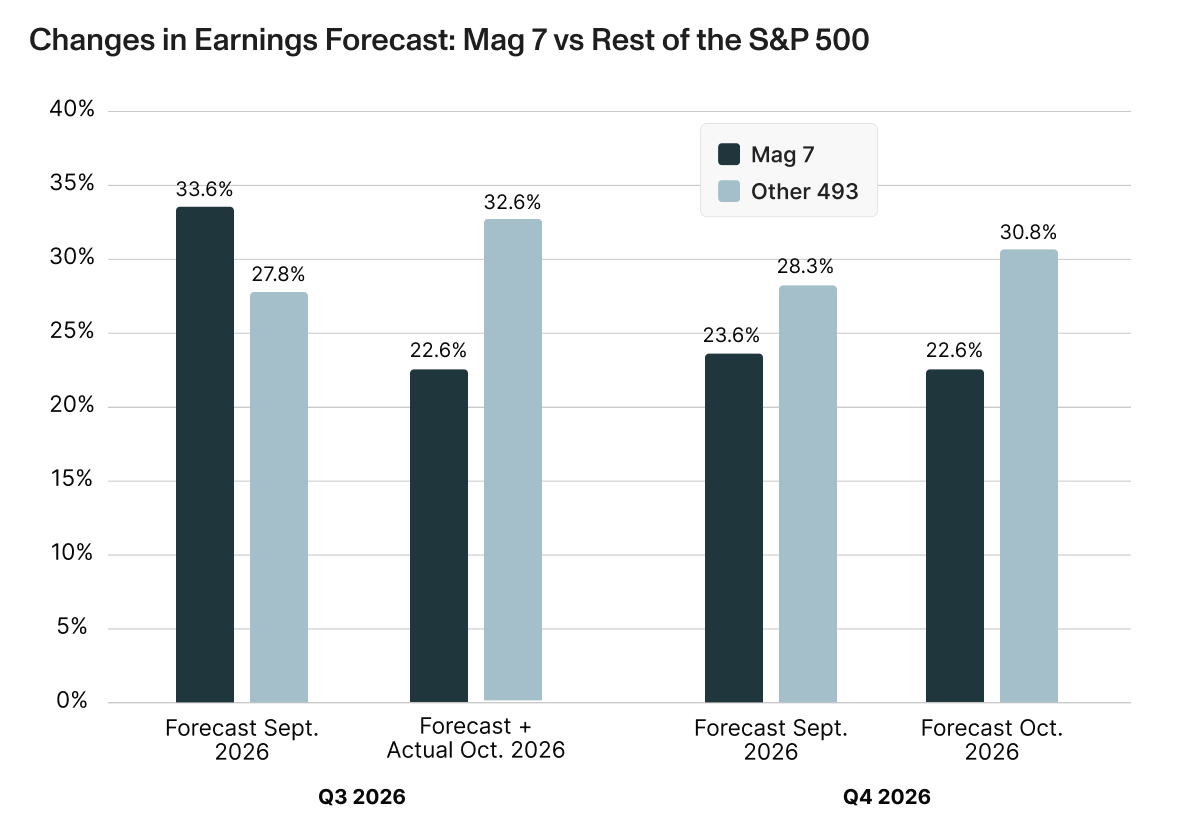
The composition of earnings growth is also beginning to change. At the end of September, the Magnificent Seven technology companies were expected to deliver substantially stronger third-quarter earnings growth than the other 493 companies in the S&P 500. By the end of October, however, blended earnings growth for the Magnificent Seven had fallen to 22.6%, while growth for the remaining companies had risen to 32.6%. The shift suggests a broadening of reported earnings growth beyond the largest technology companies. However, unusually large accounting gains or charges can distort these comparisons, so the magnitude of the apparent shift should not be interpreted as a comparable change in underlying operating performance.35
The economic and earnings data point to continued strength in underlying fundamentals. Consumer demand remains resilient, business investment continues to expand, and corporate earnings expectations are moving higher. Yet October's market performance demonstrated that strong fundamentals do not necessarily translate into uniform investment returns. Valuations, investor expectations, and the concentration of market leadership remain important determinants of performance. A broader distribution of earnings growth would be a positive development for diversified portfolios, but sustaining that progress will depend on continued economic momentum and companies' ability to convert revenue growth into durable profits.
Growth — what to watch:
- Will consumer spending and business investment sustain economic growth into 2027?
- Can earnings forecasts continue rising while growth broadens across companies and sectors?
- Whether improving fundamentals support equity returns without requiring higher valuations.
The Limits of Monetary Policy
The strength of the U.S. economy has been accompanied by a less encouraging development: inflation remains persistently elevated. September's Personal Consumption Expenditures (PCE) Price Index increased 3.6% from a year earlier, up from 3.4% in August, while core PCE inflation, which excludes food and energy, rose to 3.1%.37 Higher energy prices have contributed to renewed inflationary pressures, but the persistence of underlying inflation suggests that the challenge extends beyond volatile commodity prices. Despite considerable progress from the inflation peaks of 2022, price increases remain well above the Federal Reserve's 2% target.
Alternative inflation measures provide additional perspective. Truflation's more frequently updated estimates have recently indicated somewhat lower inflation than the official government measures, although both have shown renewed upward pressure.38 Differences in methodology, coverage, and data collection mean these measures are not directly comparable, but together they suggest that the disinflationary progress of recent years has stalled. With economic growth and consumer spending remaining resilient, the Fed faces the challenge of restoring price stability without unnecessarily constraining an economy that continues to grow at a solid pace.
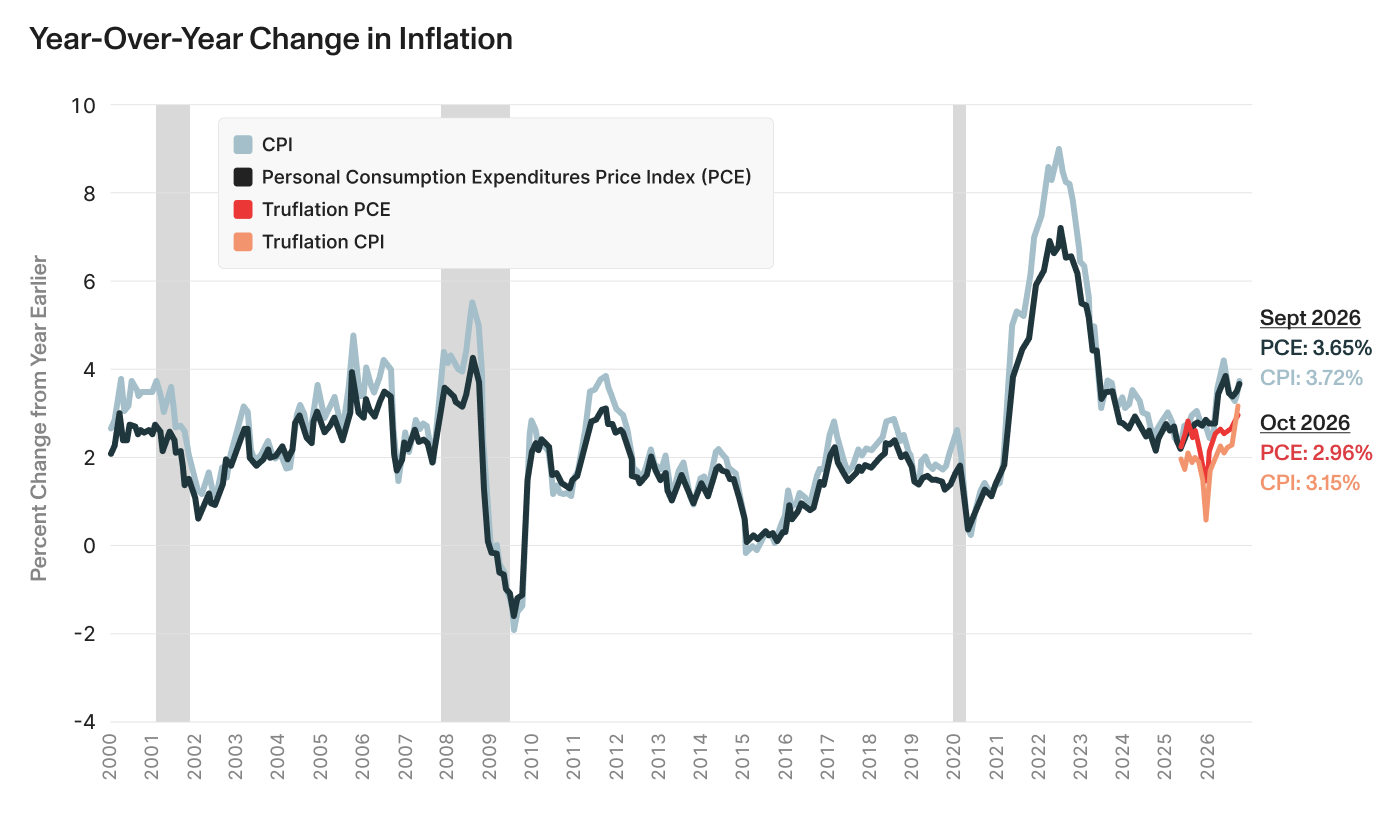
Against this backdrop, the Federal Reserve left its benchmark interest rate unchanged at 3.75%–4.00% at its October meeting.42 The decision was not unanimous: two policymakers favored a quarter-percentage-point increase, reflecting growing concern that inflation may remain above target without additional restraint. The Fed also acknowledged the strength of economic activity, resilient domestic spending, and robust capital investment. These developments have increased attention on the possibility of further tightening, rather than the timing of future rate cuts.
The implications extend beyond short-term interest rates. Although Treasury yields declined in October, longer-term borrowing costs remain elevated, creating headwinds for housing, business financing, and more highly leveraged companies. Higher interest rates also raise the return investors can earn on relatively low-risk assets, increasing the hurdle that equities and alternative investments must clear to justify their additional risks. Stronger economic growth and corporate earnings can help offset these pressures, but they also reduce the urgency for the Fed to provide additional monetary support.
Ultimately, the economy's resilience presents both an opportunity and a constraint. Continued growth and improving corporate profitability are encouraging for investors, but persistent inflation limits the Federal Reserve's flexibility and increases the importance of sustainable earnings rather than reliance on falling interest rates or expanding valuations. The path ahead will depend not only on whether economic growth remains strong, but also on whether inflation moderates enough to allow that growth to continue without additional monetary restraint.
Limits of Monetary Policy — what to watch:
- The persistence of elevated inflation.
- Will strong economic growth and continued price pressures lead the Fed to consider further tightening?
- Whether elevated borrowing costs begin to weigh more heavily on consumer spending, business investment, and corporate earnings.
Looking Ahead
As 2026 draws to a close, the economic backdrop remains encouraging. Consumer spending has been resilient, business investment continues to expand, and corporate earnings expectations are moving higher. However, October's market performance demonstrated that strong fundamentals do not guarantee uniformly strong investment returns. Persistent inflation, elevated interest rates, and growing scrutiny of AI-related capital spending are creating a more selective investment environment in which valuations, profitability, and financial discipline are increasingly important.
For investors, October's market rotation highlights the value of diversification and a long-term perspective. Higher bond yields also provide meaningful income opportunities, while the growing dispersion in equity returns places greater emphasis on valuations and earnings quality. Although economic and policy uncertainty will continue to influence markets, long-term investment outcomes will ultimately depend more on sustainable corporate profitability and the prices investors pay than on short-term headlines.
Compound provides everything you need to manage your finances (liquidity planning, concentrated position management, stock option optimization, and more).
[1] https://www.bea.gov/data/gdp/gross-domestic-product
[2] https://insight.factset.com/topic/earnings
[3] https://www.bea.gov/data/personal-consumption-expenditures-price-index
[4] https://www.federalreserve.gov/newsevents.htm
[5] https://www.spglobal.com/spdji/en/index-family/equity/
[6] https://www.spglobal.com/spdji/en/index-family/fixed-income/
[7] https://www.sec.gov/Archives/edgar/data/2130357/000162828026068676/anthropicpbc-sx1ax1.htm
[8] https://www.spglobal.com/spdji/en/index-family/equity/
[9] https://www.nasdaq.com/market-activity/index/comp/historical
[10] https://www.spglobal.com/spdji/en/index-family/equity/
[11] https://www.spglobal.com/spdji/en/index-family/equity/
[12] https://www.msci.com/end-of-day-data-search
[13] https://www.nasdaq.com/market-activity/index/comp/historical
[14] https://www.spglobal.com/spdji/en/index-family/equity/us-equity/sp-sectors/
[15] https://www.spglobal.com/spdji/en/index-family/equity/us-equity/sp-sectors/
[16] https://www.federalreserve.gov/releases/h15/
[17] https://www.spglobal.com/spdji/en/index-family/fixed-income/
[18] https://www.spglobal.com/spdji/en/index-family/fixed-income/
[19] https://kpmg.com/xx/en/media/press-releases/2026/10/global-private-equity-investment-reaches-one-and-half-trillion-as-capital-concentrates-in-fewer-larger-deals.html
[20] https://www.monitordaily.com/fitch-ratings-u-s-private-credit-default-rate-remains-elevated-in-q3/
[21] https://theleadpc.com/middle-market-private-credit-10-19-2026/
[22] https://www.globest.com/2026/10/19/real-estate-fundraising-drops-31-as-residential-and-industrial-capture-capital/
[23] https://www.sec.gov/Archives/edgar/data/2130357/000162828026068676/anthropicpbc-sx1ax1.htm
[24] https://www.sec.gov/Archives/edgar/data/2130357/000162828026068676/anthropicpbc-sx1ax1.htm
[25] https://www.npr.org/2026/10/26/nx-s1-6014772/anthropic-ai-ipo-could-break-records
[26] https://apnews.com/article/anthropic-ipo-amodei-valuation-80f77cfda96027779cccecf7741570f8
[27] https://www.sec.gov/Archives/edgar/data/2130357/000162828026068676/anthropicpbc-sx1ax1.htm
[28] https://www.npr.org/2026/10/26/nx-s1-6014772/anthropic-ai-ipo-could-break-records
[29] https://apnews.com/article/anthropic-ipo-amodei-valuation-80f77cfda96027779cccecf7741570f8
[30] https://www.bea.gov/data/gdp/gross-domestic-product
[31] https://www.bea.gov/data/gdp/gross-domestic-product
[32] https://www.atlantafed.org/research-and-data/data/gdpnow
[33] https://insight.factset.com/topic/earnings
[34] https://insight.factset.com/topic/earnings
[35] https://insight.factset.com/topic/earnings
[36] https://insight.factset.com/topic/earnings
[37] https://www.bea.gov/data/personal-consumption-expenditures-price-index
[38] https://truflation.com/indexes?tags=Inflation,Truflation%20Indexes
[39] https://www.bea.gov/data/personal-consumption-expenditures-price-index
[40] https://www.bls.gov/news.release/cpi.nr0.htm
[41] https://truflation.com/indexes?tags=Inflation,Truflation%20Indexes
[42] https://www.federalreserve.gov/newsevents.htm